This scenario plays out constantly in closely held businesses. Without a signed agreement, buyouts can spiral into disputes, lawsuits, or valuations nobody agrees on. State default law fills the gap, but it rarely matches what the owners actually intended.
This guide breaks down the key provisions every shareholder buyout agreement should contain, from triggering events to funding mechanisms.
Key Takeaways
- A shareholder buyout agreement (buy-sell agreement) locks in advance how and when ownership shares can transfer
- Strong agreements spell out triggering events, valuation methods, funding sources, and payment terms
- Life insurance is the usual way to fund buyouts after a shareholder’s death or disability
- Most plans use a cross-purchase, stock redemption, or hybrid structure
What Is a Shareholder Buyout Agreement?
A shareholder buyout agreement is a binding contract among owners that governs the sale or transfer of ownership interests. It can exist as:
- A standalone document
- A clause embedded in company bylaws
- A section within a broader shareholder agreement
The Legal Information Institute at Cornell describes this type of contract as a limit on ownership rights that forces shares of a closely held company to be resold to the business or existing owners when someone leaves or dies.
Why Businesses Need One
Without an agreement, state default law governs what happens, and that law rarely aligns with what shareholders actually wanted. Oregon's State Bar Bulletin puts it plainly: a departing shareholder without a buy-sell agreement has no right to payment for the value of their interest, and establishing a fair price becomes difficult once relationships have soured.
A solid agreement protects the balance of voting power and keeps outside buyers, including an ex-spouse who ends up with shares after a divorce, from gaining unwanted control.
Key Provisions Every Shareholder Buyout Agreement Should Include
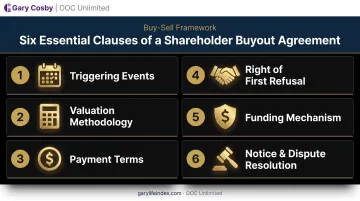
A complete agreement answers six questions. Miss one, and you've left a gap that surfaces exactly when tensions are highest.
1. Triggering events clause Defines the specific circumstances that force a buyout: death, disability, retirement, divorce, or termination. Each trigger should be labeled mandatory or optional.
2. Valuation methodology clause Specifies whether price comes from a fixed formula, an independent appraisal, or book value. This must be locked in before a triggering event, not negotiated during one.
3. Payment terms clause Covers lump sum versus installment payments, interest rates, and typical timelines for buyout payouts.
4. Right of first refusal clause Requires shares to be offered internally before any outside sale. This is the primary defense against unwanted third-party owners.
5. Funding mechanism clause Names the specific source of buyout funds. Many agreements designate life insurance policies to guarantee cash is available exactly when a triggering event occurs.
6. Notice and dispute resolution clause Specifies communication requirements when a triggering event happens and how disagreements over valuation or terms get resolved, including mediation, arbitration, or court.
J.P. Morgan's private bank notes that written expectations reduce ambiguity and lower the likelihood of disputes among co-owners.
Triggering Events That Activate a Buyout
A buyout only activates when the agreement names a clear triggering event. Common triggers include:
- Death: remaining owners purchase the deceased shareholder’s interest from the estate
- Disability: long-term inability to work can require or allow a share purchase
- Retirement or voluntary resignation: planned exit on pre-agreed price and timing terms
- Divorce: keeps an ex-spouse from becoming an unintended owner
- Bankruptcy: prevents shares from passing to creditors
- Involuntary termination: covers firing for cause or without cause, depending on the clause
Can You Force a Buyout of a Shareholder?
Sometimes. It depends entirely on whether the agreement includes a mandatory buyout clause tied to a specific trigger, such as termination for cause or breach of a non-compete. A right of first refusal alone doesn't force anything: it is a first-offer protection, not a compulsory sale mechanism.
How Long After a Buyout Do Shareholders Get Paid?
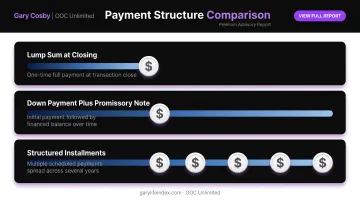
Payment timing is whatever the agreement specifies. Typical structures include:
- Lump sum at closing: simple, but requires immediate liquidity
- Down payment plus promissory note: cash upfront, balance financed
- Structured installments: payments spread over several years with defined interest and security terms
Valuation Methods and Funding Options
Getting the price right, and agreeing on it in advance, prevents most buyout disputes before they start.
Valuation Approaches
| Method | Best for | Trade-off |
|---|---|---|
| Book value | Simplicity | Often understates real business value |
| Formula (multiples) | Repeatable calculations | Needs clearly defined inputs |
| Independent appraisal | Accuracy at time of trigger | Costs time and money |
Professional business valuations for buyout purposes typically run $6,000 to more than $20,000, according to Mariner Wealth Advisors, depending on scope and complexity.
Funding Sources
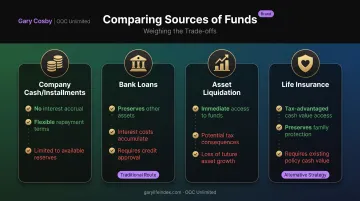
Once the price is set, someone has to pay it. Common sources:
- Company cash or installments: Works when reserves are strong; installments can strain cash flow over time
- Bank loans: Brings in outside capital, but approval and personal guarantees are not guaranteed
- Asset liquidation: Frees capital quickly, often at the cost of operating capacity
- Life insurance: Creates liquidity at death (and sometimes disability) without draining the business
Death and disability are among the most disruptive triggering events. There is no warning, and the payout obligation arrives immediately.
Many businesses cover that obligation with life insurance on each shareholder so cash is available when it is needed, instead of being pieced together after the fact. Gary Cosby Jr. of OOC Unlimited helps business owners compare insurance-funding options for buy-sell agreements. He stays on the funding side; the owner’s CPA and attorney handle legal drafting and tax structure.
Tax Considerations
How you fund the buyout also affects how the IRS taxes it. IRS Publication 542 distinguishes ordinary corporate distributions from stock-redemption rules under Section 302. A redemption that qualifies under Section 302 is generally treated as a sale; one that does not may be taxed as a dividend.
The agreement’s structure drives the tax outcome, not the label on the contract. Confirm treatment with tax counsel before you lock in terms.
Types of Shareholder Buyout Agreements
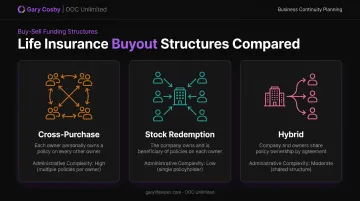
Three structural options exist, and the choice affects who owns the insurance policy and who's on the hook to buy.
Cross-purchase agreements
Remaining shareholders personally buy the departing owner's shares. Each owner typically holds a policy on every other owner — which gets administratively heavy fast. A CPA Journal analysis notes that seven owners could require 42 separate policies under this structure.
Stock redemption agreements
The company itself repurchases the departing shareholder's shares using company-owned policies. One policy per shareholder keeps the count linear as the group grows, which centralizes administration and scales more cleanly than cross-purchase.
Hybrid agreements
The company gets first option to buy; if it declines or can't fund the purchase, the remaining shareholders step in. This flexibility comes with a cost. Clear election deadlines and funding rules must be spelled out to avoid confusion at the worst possible time.
Frequently Asked Questions
What does a shareholder buyout agreement look like in practice?
A typical example: a two-owner corporation with a cross-purchase agreement, where each owner carries a life insurance policy on the other to fund a buyout at death. Templates exist, but customization with an attorney is strongly recommended.
How long after a buyout do shareholders get paid?
Payment timing depends entirely on the agreement's terms, ranging from an immediate lump sum to structured installments paid out over several years with interest.
Can you force a buyout of a shareholder?
Only if the agreement includes a mandatory buyout clause tied to a specific triggering event, such as termination or bankruptcy. Without that clause, a forced sale generally isn't enforceable.
What happens if a business has no buyout agreement at all?
State default rules take over, which can lead to disputes, unwanted outside owners gaining shares, or costly litigation to sort out fair value.
Do buyout agreements need to be reviewed regularly?
Yes. Review annually, or any time ownership, valuation, or business circumstances change significantly. A stale valuation clause is one of the most common causes of buyout disputes.