A buy-sell agreement is a legally binding contract that spells out what happens to an owner's stake when they die, retire, become disabled, or exit the business. Many people assume these agreements are just for large corporations with boards and shareholders. They're not. Small businesses, where ownership sits with two or three people, are often more vulnerable to this kind of disruption, not less.
This article covers what a buy-sell agreement is, the main types, key provisions to understand, how to fund one, and how to get started.
Key Takeaways
- Locks in what happens to ownership if an owner dies, retires, becomes disabled, or leaves
- Offers three main structures: cross-purchase, entity-purchase, and hybrid
- Life insurance funding covers buyouts without draining business cash
- Skipping an agreement risks disputes, forced sales, or unwanted new owners
- Build with an attorney, CPA, and insurance specialist; review every 2–3 years
What Is a Buy-Sell Agreement and Why Small Businesses Need One
A buy-sell agreement is a contract that governs the transfer of ownership interest when a "triggering event" occurs, such as death, disability, retirement, divorce, or a partner simply wanting out. It specifies who can buy the departing owner's share, how that share will be valued, and how the purchase will be funded.
Small businesses are particularly exposed here. In a partnership, LLC, or S-corp with two or three owners, each person typically holds a large percentage of the company. When one owner exits unexpectedly, there's no diluted shareholder base to absorb the shock.
A 2017 Wilmington Trust survey found that 58% of privately held business owners surveyed lacked a transition plan. That's a broader succession statistic, not a precise figure for two-owner small businesses, but it points to the same gap: most owners haven't put a plan on paper.
Without an agreement, a small business risks:
- Business continuity problems — operations stall while ownership questions get sorted out
- Unfair outcomes — a departing owner or their family may wait months or years for payment
- Unwanted new owners — shares could pass to an ex-spouse, an uninvolved heir, or a creditor
- Forced liquidation if no one can agree on next steps or afford a buyout
Consider a two-partner veterinary practice. One partner dies suddenly. His widow inherits his 50% stake, but she has no veterinary background and no interest in running the practice.
The surviving partner wants to buy her out, yet there's no price mechanism and no funding source. Months of tense negotiation follow, and the practice's value erodes while clients grow uneasy. A buy-sell agreement, paired with life insurance, could have resolved this in weeks.
Types of Buy-Sell Agreements
Small businesses usually choose one of three structures. The right fit depends on owner count and who should fund the buyout.
Cross-Purchase Agreement
Under a cross-purchase agreement, the remaining owners personally buy the departing owner's share. Each owner typically holds a life insurance policy on every other owner, so proceeds fund the purchase directly.
This structure works well for businesses with two or three owners, since the number of required policies stays manageable. Add a fourth or fifth owner, and the policy count grows quickly.
Entity-Purchase (Redemption) Agreement
Under an entity-purchase agreement, the business itself buys back the departing owner's interest, often using company-owned life insurance. The business owns and pays for the policy on each owner and receives the death benefit directly.
Administration is simpler: you generally need one policy per owner rather than one for every pairing, which helps as the owner count rises.
Hybrid Agreement
A hybrid, or "wait-and-see," agreement combines both approaches. Remaining owners typically get the first chance to buy the departing owner's interest. If they decline or can't fund it, the business steps in as a secondary buyer.
That flexibility only works with clear language on the decision sequence, funding responsibility, and timeline. Without it, confusion can hit at the worst possible moment.
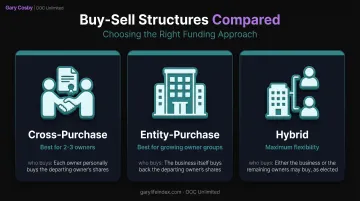
| Type | Who buys | Best for |
|---|---|---|
| Cross-purchase | Remaining owners | 2–3 owners |
| Entity-purchase | The business | Growing owner groups |
| Hybrid | Owners first, then the business | Maximum flexibility |
Key Provisions Every Small Business Owner Should Understand
Triggering Events and Valuation
The agreement needs to name every event that triggers a buyout: death, disability, retirement, divorce, bankruptcy, voluntary departure, or termination. Vague or missing triggers are one of the most common gaps in small business agreements.
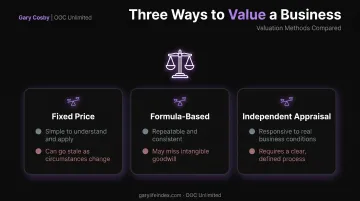
Valuation is where many agreements succeed or fail. Three common methods:
- Fixed price — simple to write, but it goes stale fast unless updated regularly
- Formula-based (such as an EBITDA multiple or book value) — repeatable, but formulas can miss goodwill or fail to reflect a sudden change in the business
- Independent appraisal — more responsive to current facts, but requires naming who appraises, when, and how disputes get resolved
Transfer Restrictions and Payment Structure
Transfer restrictions keep shares from ending up with outside parties, ex-spouses, or heirs who have no interest in running the business. The agreement should also spell out how the buyout gets paid:
- A lump sum at closing
- Installments over several years, with defined interest and security terms
Many owners fund these obligations with life insurance so cash is available when a trigger hits, instead of pulling from operating reserves.
A three-partner accounting firm used a formula tied to average annual revenue over the trailing three years, set by an outside CPA firm and revisited every two years. When one partner retired early, the formula gave both sides a number they already trusted. The transition closed in under a month: no lawsuits and no drawn-out negotiation.
Funding the Buy-Sell Agreement: Why Insurance Matters
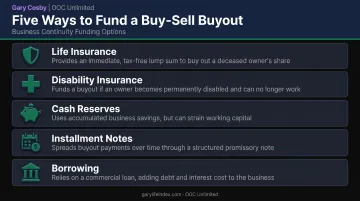
A valuation method is only useful if there's money to complete the purchase when a trigger hits. Common funding routes include:
- Life insurance — provides immediate liquidity at death without draining operating cash
- Disability insurance — funds a buyout triggered by an owner's incapacity
- Cash reserves — a sinking fund built up over time
- Installment notes — the business pays the departing owner over several years
- Borrowing — taking on debt to complete the purchase
Life insurance is the most common funding tool for death-triggered buyouts. When an owner dies, the business or the remaining owners need cash immediately, not months later after loans get approved or reserves get liquidated. A death benefit delivers cash when the buyout obligation comes due.
Disability insurance gets far less attention, even though a disabling injury or illness can trigger the same buyout obligation as death, just without a death benefit to fund it. Owners often insure against the trigger they think about most and overlook the one more likely to happen during a working career.
A licensed insurance professional, like Gary Cosby at OOC Unlimited, can help business owners evaluate insurance-funding options for buy-sell needs. Gary's role centers on the insurance-funding piece; the legal agreement itself still needs an attorney, and the valuation needs a CPA or appraiser. Coordinating the insurance, legal, and tax roles is what makes a buy-sell agreement work when it's needed.
Building and Maintaining Your Agreement
Draft the agreement early, ideally when the business forms or when a new owner joins. Waiting until a crisis is already unfolding is the worst time to negotiate valuation and funding terms.
Put a small specialist team in place before terms are locked in:
- An attorney to draft an enforceable agreement
- A CPA to handle valuation and tax structure
- An insurance specialist to evaluate funding options
Review the agreement every 2-3 years, or right after major changes such as business growth, a new partner, or a shift in tax law.
Common pitfalls to watch for:
- Outdated valuations that no longer reflect the business's worth
- Vague trigger language that leaves room for dispute
- Overlooked triggers such as divorce or bankruptcy that only surface after the fact
Frequently Asked Questions
Do small businesses with only two owners really need a buy-sell agreement?
Yes. With only two owners, a single triggering event, like death or disability, can cause major disruption or force a sale nobody wanted. There's no larger ownership base to absorb the impact.
What happens if a small business doesn't have a buy-sell agreement in place?
Ownership can end up in probate disputes, forced liquidation, or pass to unintended parties such as an ex-spouse or uninvolved heir. None of these outcomes serve the business or the remaining owners.
How much does it cost to set up a buy-sell agreement?
Costs vary based on the number of owners, entity structure, and valuation complexity. Attorney-drafted agreements cost more than templates upfront, but the enforceability is generally worth the investment.
Can a buy-sell agreement be part of an LLC's operating agreement?
Yes. Buy-sell provisions can be embedded directly in an operating agreement or created as a standalone document. Either way, the provisions need clear triggers, valuation methods, and payment terms.
What's the best way to fund a buy-sell agreement for a small business?
Life and disability insurance are popular because they deliver funds exactly when they're needed, without straining business cash flow or forcing owners to borrow under pressure.
How often should a buy-sell agreement be updated?
Review it every 2-3 years, or sooner after significant ownership changes, business growth, or shifts in tax law that affect valuation.