The choice affects whether a key executive can walk away with the full benefit the day after receiving it, or whether they need to stick around to unlock it. That's not a minor detail. It shapes your entire retention strategy.
This guide breaks down both structures side by side, so you can figure out which one actually fits your business. Licensed agents at OOC Unlimited/GFI regularly help business owners weigh these insurance-funded options before bringing in a CPA or attorney to finalize the details.
TL;DR
- REBA is a standard 162 plan with a restrictive endorsement on top, not a separate product
- Standard 162 plans give immediate unrestricted ownership; REBA adds vesting before cash-value access
- Simplicity and clean deductions favor a standard plan; turnover risk favors REBA
- Both cost less to run than deferred compensation or split-dollar arrangements
- Retention risk is the real deciding factor; tax treatment is nearly identical either way
REBA vs 162 Bonus Plan: Quick Comparison
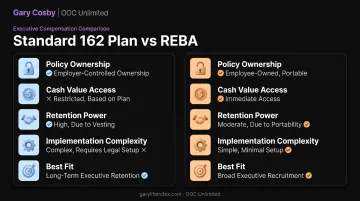
| Factor | Standard 162 Plan | REBA |
|---|---|---|
| Policy ownership | Executive owns the policy outright from day one, including cash value access and beneficiary rights. | Executive owns the policy and death benefit from day one, but a restrictive endorsement limits control until vesting. |
| Cash value access | Immediate and unrestricted. The executive can borrow against, surrender, or access the policy anytime. | Requires employer consent until specific vesting conditions are met. |
| Retention power | Minimal. Nothing stops an executive from taking the fully funded policy and leaving the next day. | Built-in golden handcuffs. Leaving early can trigger forfeiture or repayment obligations. |
| Implementation | Straightforward. No ERISA nondiscrimination testing, no contribution limits, minimal legal drafting. | More drafting care required: endorsement language, vesting schedule, and forfeiture terms all need precision. |
| Best fit | Trusted, long-tenured owners or partners with low flight risk. | Competitive labor markets where losing a trained executive is expensive. |
What Is a Standard 162 Bonus Plan?
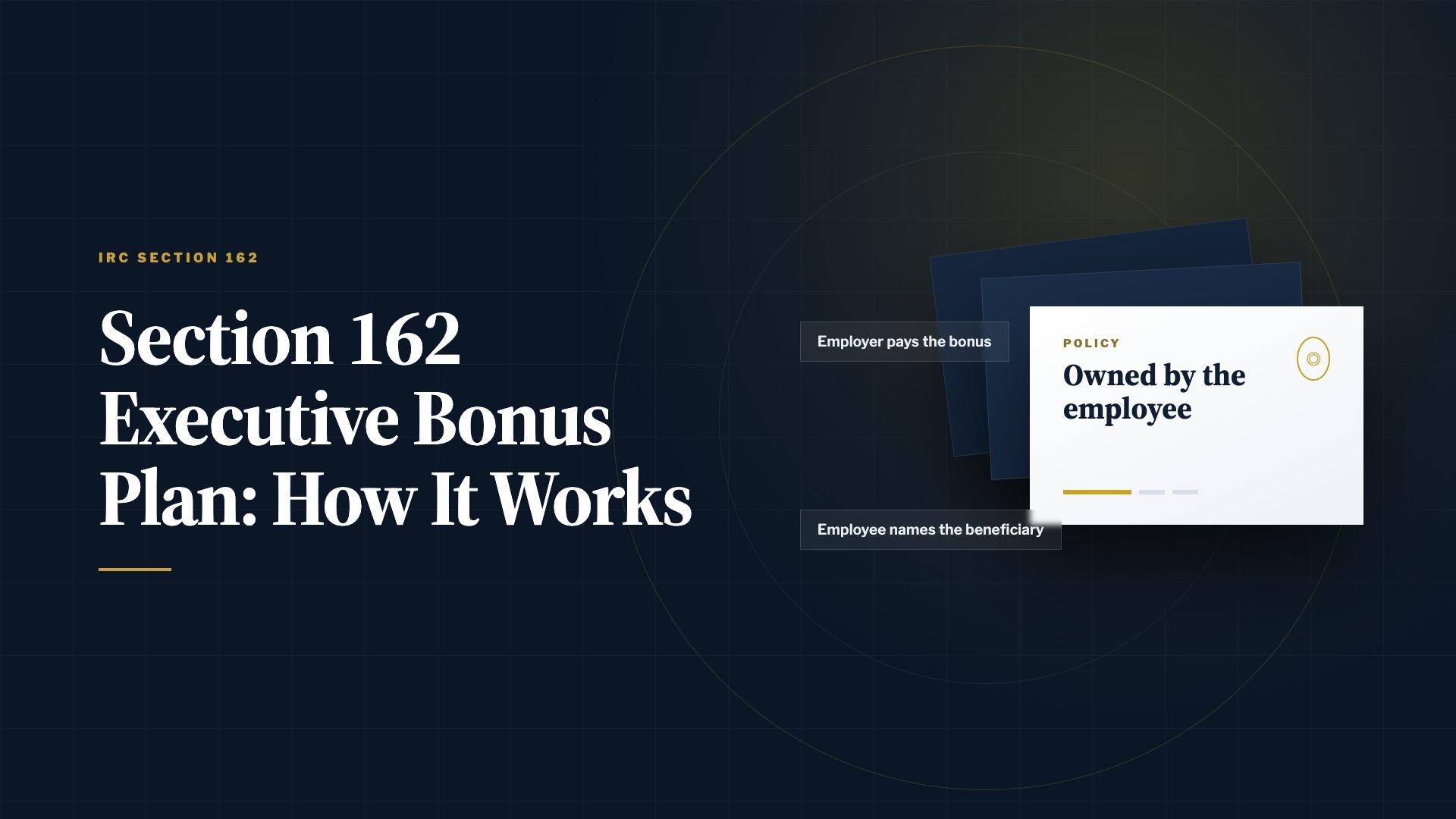
A Section 162 bonus plan lets an employer pay a bonus to a key employee, who uses it to fund a permanent life insurance policy they own. The employer generally deducts the bonus as compensation under IRC Section 162, and the executive gets immediate control over the policy's cash value, loans, and beneficiary designation.
Why business owners like it:
- No ERISA nondiscrimination testing or contribution limits
- Employers can selectively choose which executives participate — no need to offer it company-wide
- Deduction generally tracks the year the bonus is included in the executive's income
Many plans use a "double bonus" (or gross-up) design, where a second bonus covers the executive's income tax liability on the first. This doesn't make the benefit tax-free — both bonuses are still taxable compensation — but it does mean the executive isn't paying out of pocket to fund their own policy.
That simplicity is why fit matters as much as tax treatment.
Use Cases of Standard 162 Plans
Standard 162 plans work best when turnover risk is low. Typical fits include:
- Owner-employees with long tenure at the company
- Trusted partners with equity or deep personal stake in the business
- Small-to-midsize firms that want a meaningful benefit without complex legal agreements
Compared with qualified plans like a 401(k), a standard 162 plan is usually simpler:
- No IRS plan approval required
- No nondiscrimination testing
- No ongoing qualified-plan administration
That makes it practical when you want to reward a handful of people without building a full benefits infrastructure.
What Is a REBA?
A Restricted Executive Bonus Arrangement (REBA) builds on the Section 162 bonus plan by adding a restrictive endorsement. Until vesting conditions are met, the employer's consent is required before the employee can access cash value, surrender the policy, or borrow against it.
The executive still owns the death benefit and controls beneficiary designation from day one. What's restricted is access to the cash value, not the underlying protection.
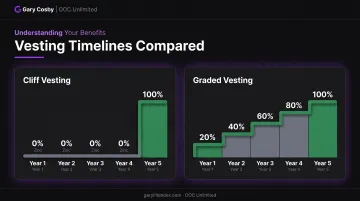
Vesting typically works one of two ways:
- Cliff vesting: all-or-nothing. The executive gets zero access until a set date (say, five years), then full access all at once.
- Graded vesting: incremental. Access might increase by 20% each year, similar to how restricted stock units vest.
If the executive leaves before vesting, forfeiture provisions can require repayment of bonuses already paid or a return of policy value. That creates a real disincentive against leaving early.
Use Cases of REBAs
REBAs make the most sense where losing a trained employee is genuinely costly. That includes:
- Law firms and professional services with long partner-track onboarding
- Sales-driven organizations where top performers are frequently recruited
- Businesses with extended training or ramp-up cycles for specialized roles
In these settings, the bonus stops being pure compensation and starts functioning as a retention tool. The executive has a real financial reason to stay through the vesting period rather than take the policy and walk.
REBA vs 162 Plan: Which Is Better for Your Business?
There's no universal right answer here. The decision comes down to three questions:
- How much turnover risk are you actually facing?
- How much do you trust this executive to stay without a contractual incentive?
- How much control do you want to retain over the benefit after they leave?
Choose a standard 162 plan if the executive is a long-tenured owner or trusted partner who isn't likely to leave regardless of the benefit structure.
Choose a REBA if you're bonusing someone relatively new, someone in a competitive role, or someone competitors would happily poach — and you want the benefit tied to their continued employment.
Many businesses don't choose one from scratch. They add REBA restrictions on top of an existing 162 plan once they realize the original design left them exposed.
Structuring the endorsement language and vesting schedule correctly matters as much as the decision itself. Licensed agents at OOC Unlimited help business owners explore insurance-funding options and coordinate the tax and legal details with their CPA and attorney.
Real-World Example: Retention Impact of Choosing REBA
A mid-sized professional services firm, a law practice, used a standard 162 plan to reward its rising partners. It worked until it didn't.
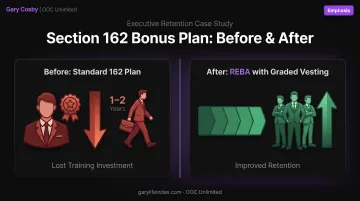
The problem: Partners received sizable bonuses to fund their policies, then left for competing firms within a year or two. The standard plan gave them full, unrestricted ownership immediately, so they walked away with a fully funded policy and no penalty.
The firm had sunk years of training investment into people who cashed out and left.
The fix: The firm restructured its 162 plan by adding a REBA endorsement with graded vesting over five years. New bonuses were tied to continued employment, and early departures triggered repayment on the unvested portion.
The takeaway: Adding the restriction converted a pure compensation tool into a retention tool. Same offer; different terms for keeping it.
If your 162 plan is rewarding people who may leave anyway, talk with a licensed insurance professional before your next bonus cycle.
Conclusion
Neither REBA nor a standard 162 plan is objectively better. The right call depends on how much retention risk your business is willing to accept versus how much simplicity you want in exchange.
A standard plan keeps things clean and deductible with minimal legal complexity. A REBA adds friction that protects your investment in a key employee, at the cost of more careful drafting upfront. Either way, the practical payoff is similar: lower turnover costs and deductible compensation that supports executive loyalty.
That outcome depends on structuring the plan and endorsement language correctly from the start, with guidance from a licensed agent.
Frequently Asked Questions
What is an executive bonus plan?
An employer-funded bonus, deductible under IRC Section 162, that a selected employee uses to buy a life insurance policy they own. The employee receives both death benefit protection and cash value growth.
What is bonus life insurance?
Bonus life insurance is the policy funded by a Section 162 executive bonus. The employee is both the insured and the policy owner.
How is the bonus calculated for life insurance?
Employers usually base the bonus on the annual premium needed to reach a coverage or cash value target. Many add a "double bonus" so the payment also covers the employee's income tax on the bonus.
What is a REBA in life insurance?
A Restricted Executive Bonus Arrangement limits the employee's access to policy cash value until vesting conditions are met, which creates a retention incentive. The employee still owns the death benefit from day one.
Can a business owner participate in their own 162 or REBA plan?
C-corp owner-employees can participate like any other executive. S-corp shareholders and sole proprietors face different tax treatment, so guidance from a CPA is essential.
What happens to the policy if the executive leaves before REBA vesting?
Forfeiture provisions may require repayment of bonuses or return of unvested policy value. Under a standard 162 plan, the employee keeps the policy and its value no matter when they leave.