
Many policyholders don't realize they're sitting on accessible funds. Others withdraw without understanding the trade-offs. Here's the direct answer: yes, you can withdraw cash value, but it comes with rules, costs, and consequences for your coverage.
This guide covers who qualifies, the three main withdrawal methods, tax implications, and how pulling money out affects your death benefit.
Key Takeaways
- Only permanent policies (whole life, universal life, variable universal life) build cash value; term life does not
- Access cash value three ways: partial withdrawal, policy loan, or full surrender, each with different tax rules
- Withdrawals reduce your death benefit and may create taxable income on gains above premiums paid
- Model scenarios with a licensed agent before you commit to one access method
Does Your Policy Have Cash Value to Withdraw?
Not every life insurance policy builds cash value. Permanent policies do; term policies don't.
Whole life, universal life, and variable universal life combine a death benefit with a savings component. Part of your premium funds that savings account, which grows over time. Term life insurance, by contrast, provides coverage for a set period with no savings element—there's nothing to withdraw.
According to the NAIC, permanent policies carry higher premiums specifically because of this built-in cash value feature. That value doesn't build at a fixed rate across every policy:
- Some policies accumulate slowly at first, then grow faster in later years
- Others build more steadily from the start
- Growth depends on premium structure, policy design, and (for whole life) any dividends the insurer declares
New York Life notes that cash value generally starts accumulating after the first policy year, though guaranteed whole-life value often isn't credited until after the second anniversary. Insurers estimate it typically takes 2 to 10 years before you have enough built up to meaningfully borrow against or withdraw, according to Guardian.

How to check your current cash value:
- Review your most recent policy statement
- Log into your insurer's client portal
- Call your insurer directly
- Ask your agent for an in-force illustration
Cash Value of a $100,000 Whole Life Policy
Here's a common misconception: a $100,000 death benefit does not mean $100,000 in cash value. These are two different numbers.
Cash value depends on:
- How much premium you're paying
- How long the policy has been active
- The policy's specific structure and guarantees
- Any dividends the insurer has declared (for whole life)
A policyholder paying higher premiums for fewer years builds cash value differently than one paying lower premiums over a longer stretch. There's no universal chart that applies to every $100,000 policy—your actual figure depends entirely on your specific contract.
Want your real number? Request an in-force illustration from your insurer or agent. This document shows your policy's actual accumulated cash value, not a generic estimate.
How to Withdraw Cash Value From Your Life Insurance
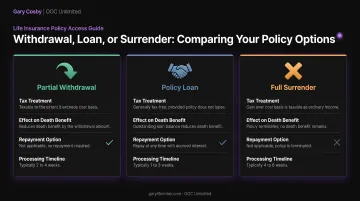
You've got three main paths, plus a fourth option that uses cash value to keep coverage in force. Each works differently.
Partial Withdrawal
You take out a portion of your cash value directly. Withdrawals up to your cost basis, meaning the total premiums you've paid, are generally tax-free. Anything beyond that basis counts as ordinary income. The withdrawal also reduces your death benefit by about the same amount.
Policy Loan
You borrow against your cash value, which acts as collateral. Key details:
- Interest rates typically run 5% to 8%, per New York Life
- Not taxable as long as the policy stays active
- Interest accrues daily; unpaid interest gets added to your loan balance
- No credit check required in most cases
- Outstanding loans reduce the death benefit until you repay them
Full Surrender
You cancel the policy entirely and collect the accumulated cash value, minus any surrender charges. This ends your coverage completely. The IRS treats gains above your cost basis as ordinary income. Revenue Ruling 2009-13 walks through an example: $78,000 received against a $64,000 investment produced $14,000 in taxable income.
Using Cash Value to Pay Premiums
If money's tight, some policyholders tap cash value to cover premium payments and keep coverage active during a rough financial stretch. This buys time without lapsing the policy, though it draws down the very reserve you might need later.
Processing times vary by insurer and request type:
| Method | Typical Timeline |
|---|---|
| Policy loan | A few days to 3 weeks |
| Full surrender | 2 to 6 weeks |
What Happens When You Withdraw Cash Value?
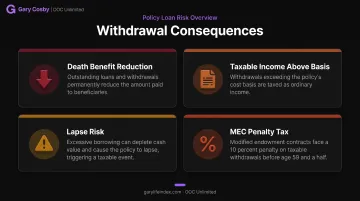
Pulling cash out isn't free of consequences. Four things happen, in varying combinations:
- Death benefit drops dollar-for-dollar, and sometimes more, depending on your policy's terms
- Amounts above your cost basis are taxed as ordinary income under federal rules (26 U.S. Code § 72)
- Lapse risk rises if withdrawals or an unpaid loan drain the cash value needed for premiums. Your insurer may require you to resume payments, or the policy could lapse
- MEC policies (those that failed the IRS 7-pay test) tax withdrawals growth-first. Take money out before age 59½ and you'll likely owe a 10% penalty on top of ordinary income tax, according to Northwestern Mutual
Weighing the Trade-Offs: Is Withdrawing Cash Value Right for You?
Before you pull money from your policy, ask what you're really giving up. Every dollar withdrawn is a dollar less protecting your family later.
Alternatives worth comparing first:
- Personal loans (no policy risk, but interest rates vary widely)
- Home equity loans or lines of credit
- Retirement account loans (401(k) loans typically cap at 50% of vested balance or $50,000, with repayment in five years)
A policy loan often carries lower interest than a personal loan or credit card, but it directly puts your death benefit at risk if left unpaid. A home equity loan might actually beat a policy loan on rate, depending on your situation.
This is where working with a licensed professional pays off. At GFI, our agents have access to a network of 25+ A+ rated carriers, including Prudential, Allianz, and Lincoln Financial, so recommendations aren't limited to one insurer's lineup.
We help you see what your specific policy allows, compare the real cost of a withdrawal versus a loan versus a full surrender, and keep your family's coverage intact while still giving you flexibility when expenses hit.
The right move depends on your policy and timeline. What works five years into a whole life contract looks different from an indexed universal life policy that's grown for two decades.
Frequently Asked Questions
What happens if I withdraw cash value from my life insurance?
Your death benefit decreases, and any amount withdrawn beyond your cost basis becomes taxable as ordinary income. If withdrawals leave insufficient cash value to cover premiums, your policy could lapse.
What is the cash value of a $100,000 whole life insurance policy?
It varies significantly based on your premium amount, how long the policy's been active, and your specific insurer. Request an in-force illustration for your exact figure.
Can I withdraw money from my life insurance without penalty?
Early withdrawals may face surrender charges. Amounts up to your cost basis are typically tax-free; gains above basis are ordinary income. MECs tax gains first and may add a 10% penalty before age 59½.
Is borrowing against cash value better than withdrawing it?
Loans accrue interest but are generally not taxable while the policy stays active, and you can repay them. Withdrawals are permanent reductions with no repayment option, though they're tax-free up to basis.
How long does it take to get cash value from a life insurance policy?
Policy loans often process within a few days to three weeks. Full surrenders typically take two to six weeks, depending on your insurer and policy complexity.
Does withdrawing cash value cancel my policy?
No. Partial withdrawals and policy loans keep your policy active. Only a full surrender cancels the policy and ends your coverage entirely.