
Family business exits carry a weight that standard business sales don't. Money matters, but so do relationships, legacy, and the identity an owner built over decades. Getting it wrong doesn't just cost dollars. It can fracture families.
This guide walks through the types of exit strategies available, how to plan one step-by-step, the emotional side owners often overlook, and how insurance funding protects the transition when the unexpected happens.
Key Takeaways
- A documented exit strategy protects business value and family relationships
- Owners can choose from several exit paths, including succession, sale, and ESOPs
- Emotional readiness matters as much as financial and legal preparation
- Life insurance funding secures buy-sell agreements and provides liquidity during transitions
Understanding Family Business Exit Strategy Planning
A family business exit strategy is a documented plan for transferring ownership and leadership, built around family dynamics, legacy goals, and financial needs. A standard business exit plan focuses mostly on valuation and buyer terms. A family exit plan also has to settle who inherits what, who leads next, and how relationships survive the process.
Family firms don't reliably survive to the next generation. Harvard Business Review's analysis of the "three-generation rule" finds that most family businesses don't make it past the third generation of ownership.
The bigger problem is preparation, not intention. According to PwC's continuity and succession planning research, only 34% of US family businesses have a robust, documented, and communicated succession plan.
That leaves a majority of family businesses exposed to:
- Leadership gaps if an owner exits unexpectedly
- Disputes among heirs with no agreed-upon process
- Lower sale valuations due to owner-dependent operations
- Tax exposure from unplanned transfers
The 5 D's of Succession Planning Every Owner Should Know
Not every exit happens on schedule. The Exit Planning Institute identifies five unplanned triggers, known as the 5 D's, that force owners out before they're ready:
- Death — A leader's sudden death leaves a leadership void and often no clear successor.
- Disability — Illness or injury can sideline a key owner or executive without warning.
- Divorce — Spousal ownership stakes can force asset division that destabilizes the company.
- Disagreement — Conflict among partners or family members can escalate into a forced buyout or dissolution.
- Distress — Financial pressure, market shifts, or industry disruption can force an exit before the owner is ready.
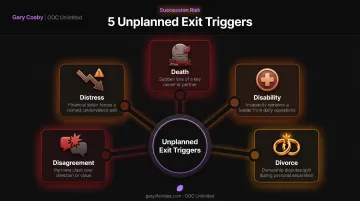
You cannot control when one of these hits. You can control whether a plan is already in place. A properly funded buy-sell agreement, updated legal documents, and clear contingency plans cushion the financial blow and keep the transition manageable.
7 Types of Family Business Exit Strategies to Consider
5 Types of Family Business Exit Strategies to Consider
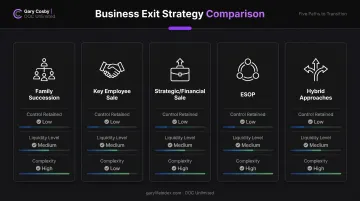
There isn't one "right" way to exit a family business. The best path depends on your goals, your heirs, and your timeline.
Family Succession
Transferring ownership to the next generation keeps the business—and its legacy—in family hands. The challenge: finding an heir who's both willing and capable. Forcing succession onto an unprepared or unwilling family member is one of the fastest ways to destroy a business.
Sale to a Key Employee or Management Buyout
Selling to a trusted manager or team keeps continuity intact. Employees know the business, customers, and culture already. Financing usually requires seller notes, bank loans, or a combination, since most employees can't pay full value upfront.
Sale to a Strategic or Financial Buyer
Selling to an outside company or investor group typically delivers the highest liquidity. It also means giving up family control entirely. Strategic buyers often pay a premium for synergies; financial buyers focus on returns and may keep management in place. This route suits owners prioritizing cash over legacy.
Employee Stock Ownership Plan (ESOP)
An ESOP sells the business to employees through a trust, preserving culture while creating liquidity for the owner. NCEO reports the ESOP sector includes 6,609 plans across 6,411 companies, with over 15 million total participants nationwide. It's a well-established, if underused, exit path.
Hybrid Approaches
Many owners combine strategies: a partial sale to an outside investor, a staged buyout by family members, or a gradual leadership handoff paired with a minority equity sale. Hybrids offer flexibility for owners who want liquidity now without giving up all control immediately.
Choosing the Right Path for Your Family
Ask these questions before committing to a strategy:
- Do you need liquidity now, or is preserving legacy more important?
- Is an heir ready, willing, and capable of running the business?
- Do you want ongoing involvement post-exit, or a clean break?
- Can the business afford the financing structure a chosen path requires?
Exit Planning Institute research shows roughly 70% of business owners prefer internal transfers over external sales. Most owners lean toward keeping the business close—whether through family, employees, or an ESOP.
How to Build a Family Business Exit Plan Step-by-Step
A good exit plan takes years, not months. Here's the sequence that matters most:
- Start early. A five-year runway gives you time to strengthen performance, reduce founder dependency, and improve valuation before you need to sell or transfer.
- Get an independent valuation. You can't plan a fair transfer or sale without knowing what the business is actually worth and what drives that value.
- Formalize operations. Document processes, delegate decision-making, and reduce reliance on any single person, including yourself.
- Address tax and legal structuring. Work with a CPA and attorney on buy-sell agreements, gifting strategies, and trusts. For 2026, the federal basic estate and gift tax exclusion is $15,000,000, with an annual gift exclusion of $19,000 per recipient.
- Document institutional knowledge. Identify and develop successors early so critical know-how doesn't leave with you.
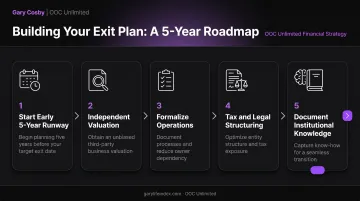
Only 20% to 30% of businesses that go to market actually sell, according to the Exit Planning Institute. That gap between listing and closing is exactly why the five-year runway matters.
How to Gracefully Exit a Family Business: The Emotional Side
Financial and legal planning gets most of the attention. The emotional side often gets ignored, and it's frequently the biggest barrier owners face.
For many owners, the business is their identity. After decades defined by that role, walking away can feel like losing purpose along with the paycheck.
Before stepping away, plan your next chapter:
- Mentor rising leaders or serve on an advisory board
- Explore hobbies or causes you postponed for years
- Stay connected to the industry through consulting or speaking
Marking the transition matters too. A legacy celebration, a formal handoff ceremony, or even a simple company-wide announcement gives employees and family a chance to honor what was built. Skipping this step often leaves both the owner and the team feeling unresolved.
Protecting Your Exit Strategy with the Right Insurance Funding
Even the best exit plan needs financial protection against the unexpected. This is where life insurance funding comes in.
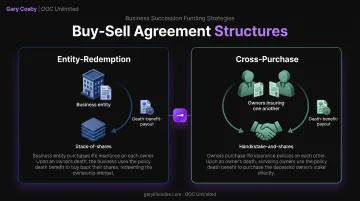
Buy-sell agreements funded by life insurance ensure a smooth transfer if a co-owner dies, becomes disabled, or exits unexpectedly. Two common structures exist:
- Entity-redemption: The business owns policies on each owner and uses the death benefit to buy back shares.
- Cross-purchase: Owners buy policies on each other, using proceeds to purchase the deceased owner's stake directly.
Key person insurance protects the company itself. If an essential founder, executive, or specialist dies, the death benefit can help replace lost revenue, fund a successor search, and reassure lenders during the gap. Separate key person disability coverage can address an owner or specialist who can no longer work.
Some policies also include optional living benefit riders for chronic, critical, or terminal illness. Those riders let a policyholder access part of the death benefit after a qualifying health event while still living. They vary by carrier and are not automatic, so confirm what is included when you compare options.
That liquidity is the gap OOC Unlimited helps close. Gary Cosby, a licensed life insurance agent, works with business owners to structure the insurance-funding piece of an exit plan.
He does not draft the buy-sell agreement or set the business's value. Those roles stay with the attorney and the valuation professional. His focus is making sure the agreement has cash available when a triggering event hits.
Insurance funding doesn't replace legal or tax planning. It's the piece that makes sure the plan can be paid for when it matters.
Frequently Asked Questions
How do I gracefully exit a family business?
Start planning years in advance. Define your next chapter so emotions don't derail the process, and mark the transition with a formal handoff so employees and family feel closure.
What are the 5 D's of succession planning for family businesses?
Death, Disability, Divorce, Disagreement, and Distress. These are unplanned triggers that can force a premature exit if there's no contingency plan in place.
What is the average lifespan of a family-owned business?
Most family businesses don't survive past the third generation. Research often cited by Harvard Business Review and the Family Business Institute finds roughly 30% reach the second generation and about 12% reach the third.
What are the most common exit strategies for family business owners?
Family succession, sale to a key employee or management team, sale to an outside buyer, ESOPs, and hybrid approaches combining partial sales with staged buyouts.
How early should I start planning my business exit?
Start at least five years before you plan to exit. That window gives you room to boost valuation, reduce owner dependency, and fix tax structuring issues.
Do I need life insurance as part of my exit strategy?
Yes, in most cases. Life insurance funds buy-sell agreements and key person coverage, providing liquidity when death, disability, or another trigger forces an unplanned transition.