
The problem? Many business owners confuse split-dollar structures. There's a real difference between "economic benefit" arrangements and "loan regime" arrangements, and mixing them up can trigger costly tax mistakes.
This guide breaks down how loan regime split dollar works: the mechanics, the tax treatment, who it's built for, and the pitfalls that trip up even well-intentioned employers.
Key Takeaways
- The employer loans premium funds to an executive who owns the policy, secured by a collateral assignment
- Executives repay the loan through death benefit or cash value at rollout, retirement, or termination
- A properly structured plan avoids current income taxation on the insurance value itself
- Sarbanes-Oxley Section 402 bars this structure for top-five executives at publicly traded companies
- Interest must meet or exceed the IRS Applicable Federal Rate (AFR) to avoid imputed income
What Is a Loan Regime Split Dollar Arrangement?
In a loan regime arrangement, the employer "loans" premium payments to an executive who owns the life insurance policy. The executive then files a collateral assignment with the insurance carrier, giving the employer a security interest in the policy until the loan is repaid.
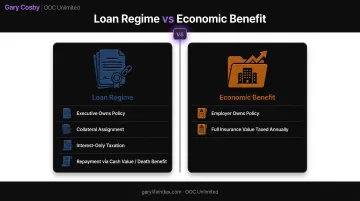
This differs from the economic benefit (endorsement) regime, where the employer owns the policy outright and the executive is taxed each year on the value of the insurance protection received. Under IRC 7872, each premium payment in a loan regime plan is treated as a separate loan.
Quick comparison:
| Feature | Loan Regime | Economic Benefit Regime |
|---|---|---|
| Policy owner | Executive | Employer |
| Annual tax hit | Interest only | Full insurance value |
| Repayment mechanism | Loan balance from cash value/death benefit | N/A |
One common point of confusion: loan regime split dollar has nothing to do with a return of premium (ROP) rider on a term policy. ROP riders refund premiums if you outlive the term. Split-dollar loans work through an entirely different repayment mechanism tied to cash value or death benefit, not a simple premium refund.
How the Loan Regime Works Step-by-Step
Setting Up the Agreement
Before a single premium dollar changes hands, the employer and executive need a formal written split-dollar agreement plus a collateral assignment filed with the carrier. Skip this step, and the whole structure falls apart.
Loans can be structured two ways:
- Demand loans: payable in full whenever the lender requests it
- Term loans: locked in for a set period, offering more predictability for both parties
Interest and the Applicable Federal Rate (AFR)
Here's the part that trips people up. Interest on the loan must be charged at or above the IRS Applicable Federal Rate to avoid imputed income problems under Section 7872.
A demand loan gets tested every calendar year it's outstanding. A term loan gets tested once, at inception, using the AFR in effect on the loan date.
Fall below AFR on a demand loan, and the IRS treats the shortfall as forgone interest, generally taxed as compensation to the executive. Not a good surprise.
Refinancing when rates drop doesn't come with the fees you'd expect from a mortgage refi. Business owners can restructure the loan and lock in a lower rate when conditions improve, according to commentary from the CPA Journal.
Repayment and Plan Termination ("Rollout")
At the executive's death, retirement, or when the plan terminates, the business is repaid the loan balance (cumulative premiums plus any accrued interest). This typically comes from either:
- The policy's death benefit, or
- The policy's cash value at rollout
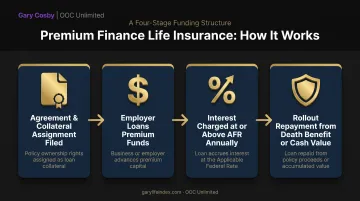
Whatever's left over above that loan balance? The executive or their family keeps it, income-tax-free.
Tax Advantages and Considerations for Business Owners
The biggest advantage of loan regime split dollar: the executive is only taxed on the interest cost each year, actual or imputed, not on the full value of the life insurance protection. That's a lighter tax burden than economic benefit plans.
Additional policy-level tax benefits:
- Tax-deferred cash value growth inside the policy
- Tax-free withdrawals up to basis
- Tax-free policy loans after basis recovery, which can support retirement income
- Death benefits pass income-tax-free to beneficiaries once the outstanding loan is repaid
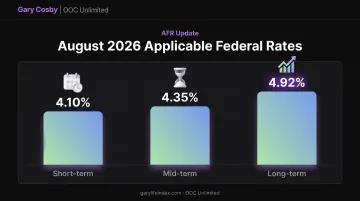
Current AFR rates matter here. As of August 2026, the IRS applicable federal rates (annual compounding) are:
| Term | Rate |
|---|---|
| Short-term | 4.10% |
| Mid-term | 4.35% |
| Long-term | 4.92% |
When rates sit lower, the spread between the loan's interest cost and the policy's potential cash value growth can widen. That arbitrage is what many business owners look for, though it isn't guaranteed.
A numbers-only approach is risky here. Before implementing anything, work with a CPA or tax attorney to model the interest cost against expected policy growth over the life of the arrangement.
Who Should Consider a Loan Regime Split Dollar Plan
Loan regime split dollar tends to work best for certain employers.
Good fits:
- Closely held or family-owned businesses retaining key executives
- Private companies wanting flexible, non-qualified retention tools
- Non-profits rewarding key personnel without triggering excess-benefit or Form 990 compensation issues
Not permitted:
Publicly traded companies generally cannot use this structure for directors and executive officers. Sarbanes-Oxley Section 402 bans personal loans to those individuals, and courts have treated loan-regime split-dollar arrangements as falling under that prohibition.
For private employers who can use the structure, vesting flexibility is another draw. Compared with standard deferred compensation plans, loan regime split dollar often allows more customized schedules—useful when the goal is keeping a key executive engaged for the long haul.
Risks and Common Pitfalls to Avoid
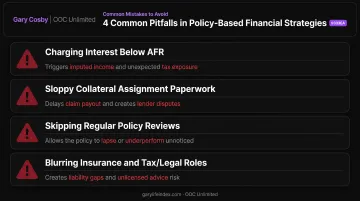
Even well-designed plans run into trouble. Watch for these common mistakes:
- Charging interest below AFR — triggers imputed income under Section 7872 and awkward mid-year surprises for the executive
- Sloppy collateral assignment paperwork — if it isn't filed correctly with the carrier, the employer's security interest is at risk
- Skipping regular policy reviews — an underfunded policy can lapse, leaving employer and executive with no coverage and no security
- Blurring insurance and tax/legal roles — treating funding, agreements, and tax treatment as one job is a common way plans unravel
Split-dollar plans need steady coordination between insurance funding and legal/tax structuring. Getting that division of labor right is often what separates a plan that runs for 20 years from one that breaks at year five.
Gary Cosby Jr. and the team at GFI focus on the insurance-funding piece: selecting the right permanent policy, sizing it, and monitoring performance over time. Agreement drafting, ownership structure, and ongoing tax treatment stay with the business owner's CPA and attorney.
Frequently Asked Questions
What is a split-dollar loan arrangement?
A loan regime split-dollar arrangement is a plan where the employer loans premium funds to a policy owned by the executive, secured by a collateral assignment. The loan is repaid later from the policy's death benefit or cash value.
Do I get all my money back with ROP?
Return of Premium (ROP) riders are separate from split-dollar loans. ROP refunds premiums on a term policy if the insured outlives the term. That is not how loan regime repayment works.
How is a loan regime split-dollar plan taxed?
The executive is only taxed on interest, whether actual or imputed, each year. That's different from economic benefit plans, which tax the full value of the insurance protection annually.
Can a public company use loan regime split-dollar for its CEO?
No. Sarbanes-Oxley prohibits loans to top executive officers of publicly traded companies. This structure is limited to private businesses and nonprofit employers.
What happens to the split-dollar loan if the executive dies?
The outstanding loan balance gets repaid to the employer from the death benefit. Any remaining proceeds pass income-tax-free to the executive's beneficiaries.
How is a loan regime split-dollar plan different from an economic benefit plan?
In an economic benefit plan, the employer owns the policy and the employee is taxed annually on its value. In a loan regime plan, the employee owns the policy and is taxed only on the loan's interest.