There was no buy-sell agreement. There was no plan.
This scenario plays out more often than most owners realize. A 2019 report on the Exit Planning Institute's survey found that 79% of business owners had no written transition plan in place. Without one, death, divorce, disability, or retirement can trigger chaos instead of an orderly transition.
This article breaks down what actually happens when there's no agreement, the worst-case outcomes owners face, and practical steps to close the gap.
Key Takeaways
- Ownership can pass to an ex-spouse, estranged heir, or an outsider you never chose
- Valuation disputes without a pre-agreed method often end in costly litigation
- State default laws rarely protect the business or match owners' actual wishes
- Life insurance is the most common way to fund a buy-sell so the buyout can close
What Is a Buy-Sell Agreement and Why It Matters
A buy-sell agreement is a legally binding contract that spells out how ownership transfers when a "triggering event" happens. Without one, there's no predetermined buyer, no agreed price, and no process. Just uncertainty at the worst possible time.
Common triggering events include:
- Death of an owner
- Disability or incapacity
- Divorce
- Retirement
- Bankruptcy
- Termination of employment
- Voluntary departure
Industry publications like The Tax Adviser describe buy-sell agreements as contracts that require an owner (or their estate) to sell their interest when specified events occur. Valuation is set in advance through a fixed price, formula, or independent appraisal.
Who Needs One
Any business with more than one owner faces this exposure. Corporation, partnership, or LLC—two owners or twenty—the structure doesn't change the risk. When ownership can transfer without a plan, uncertainty fills the gap.
The Real Consequences of Not Having a Buy-Sell Agreement
Without an agreement in place, these are the outcomes owners most often face.
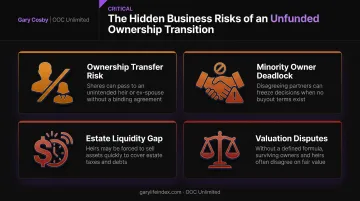
Ownership lands where you least expect it. A deceased owner's shares typically pass to their spouse, heirs, or estate. Suddenly, remaining owners are in business with someone who may have zero industry knowledge, no interest in the company's direction, or worse, an adversarial relationship with the surviving owners.
Minority owners can freeze the whole operation. A shareholder holding even a small stake can block a sale, merger, or key decision. In Wilkes v. Springside Nursing Home, Massachusetts's highest court found that close-corporation shareholders owe each other duties of good faith and loyalty.
Freezing out a minority owner without a legitimate business purpose can expose the company to litigation.
Divorce can hand a stake to an ex-spouse. Equitable distribution laws in many states treat a business interest as marital property. Without an agreement restricting transfers, a divorcing owner's ex could end up with a seat at the table.
Heirs need cash, but the business has no obligation to pay them. This is the estate liquidity problem. A deceased owner's family may urgently need money, yet without a buyout obligation and funding mechanism, the business has no way to provide it, and no legal requirement to try.
Valuation turns into a fight. Without an agreed-upon method, arguing over what the business is worth becomes inevitable. In Lynd v. Marshall County Pediatrics, one physician valued her shares at $230,000; the remaining physicians calculated $6,275 using book value.
The dispute went to the Alabama Supreme Court and was remanded for further proceedings—years of legal costs over a number two contract sentences could have settled.
These fights are common in part because so few owners plan ahead. A 2025 U.S. Bank survey of 1,000 small-business owners found that only 54% had a formal succession plan.
What Happens If There Is No Shareholder Agreement?
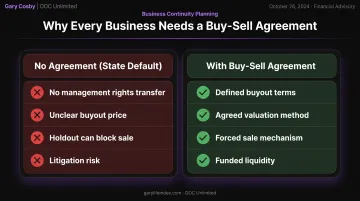
When there's no shareholder or buy-sell agreement, state default statutes take over. Those defaults govern transferability, but they rarely answer the questions owners need answered: who buys the interest, at what price, and on what timeline.
Under default rules:
- A transferred interest often doesn't include management rights, only economic rights like distributions
- The transferee doesn't automatically become a full member or shareholder
- Minority owners retain rights that can be used to block transactions or demand unfavorable buyout terms
Delaware's LLC statute, for example, says an interest is assignable unless the LLC agreement says otherwise. The assignee still doesn't get member status without consent from the other members. That sounds protective on paper. In practice, the business can sit in limbo with no clear path to resolution.
A common real-world example: a surviving owner wants to sell the company to a strategic buyer. A minority shareholder, or a deceased owner's estate holding shares, refuses to go along. Without a buy-sell agreement forcing a sale or buyout under agreed terms, that single holdout can stall the deal indefinitely.
How to Fund a Buy-Sell Agreement So It Actually Works
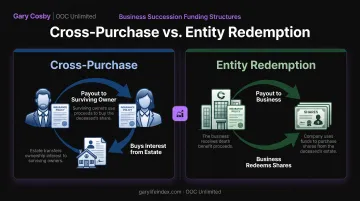
Here's a fact that surprises a lot of owners: a perfectly drafted buy-sell agreement is worthless if there's no money to execute it. If the agreement requires a buyout at death but nobody has the cash, you're back to square one. Life insurance is the standard funding tool for death-triggered buyouts. It provides immediate liquidity exactly when it's needed, without forcing owners to liquidate assets or take on debt. There are two common structures:
| Structure | How it works |
|---|---|
| Cross-purchase | Each owner buys a policy on the other owner(s). At death, the survivor uses the payout to buy the interest from the estate. |
| Entity redemption | The business owns the policies and is the beneficiary. It receives the payout and redeems the deceased owner's shares. |
| This is where coordination matters. Three roles usually share the work: |
- Attorneys draft the legal agreement
- Valuation professionals set the business value
- Licensed insurance professionals structure the funding OOC Unlimited's licensed agents focus on that third piece—helping owners choose the right policy type and carrier from 25+ A-rated companies. Your attorney and CPA still handle the legal and tax structuring.
The Connelly Ruling Changes the Math
In 2024, the Supreme Court ruled in Connelly v. United States that corporate-owned life insurance proceeds count as a business asset when valuing a deceased owner's shares—even if the company plans to use that money to redeem those shares. In that case, a $3 million redemption payout still counted toward company value and pushed the estate tax bill higher than expected. The Court noted a cross-purchase structure might have avoided the issue entirely. Funding isn't just logistics; it affects estate tax outcomes. Review the structure with your attorney and insurance professional together, not separately.
Steps to Protect Your Business Starting Today
You don't need a looming sale to justify starting this conversation. In fact, waiting for a crisis is exactly how bad terms get negotiated under pressure.
- Start the conversation now. Terms are far easier to negotiate when everyone is healthy, the business is stable, and no one has an incentive to push for unfavorable terms.
- Bring your attorney and insurance professional together. Legal terms and funding mechanisms need to work as one system, not two disconnected pieces built in isolation.
- Review the agreement regularly. Ownership changes, valuation shifts, and new tax rulings like Connelly can make an outdated agreement just as risky as having none at all.
A buy-sell agreement isn't a one-time document you file away. It's a living plan that needs revisiting as your business and your life change.
Frequently Asked Questions
What happens if there is no shareholder agreement?
State default laws take over, and they rarely reflect what owners actually want. Ownership can pass to unintended parties, and minority owners can block major decisions or sales.
What triggers a buy-sell agreement?
Standard triggers include death, disability, divorce, retirement, bankruptcy, and termination of employment. A well-drafted agreement addresses each one specifically.
Can a business be forced to sell without a buy-sell agreement?
Yes, in some cases. Courts can order dissolution or find shareholder oppression, especially when there's no agreed exit process to prevent a forced sale.
How is a business valued without a buy-sell agreement?
Value disputes typically end up in litigation or require a forensic appraisal. Both are slower and far more expensive than a pre-agreed valuation method.
Is life insurance required to fund a buy-sell agreement?
No, but it's the most common and reliable method for death-triggered buyouts. It provides immediate cash exactly when the business needs it most.
How often should a buy-sell agreement be reviewed?
Annually at minimum, and immediately after any ownership change, valuation shift, or major tax law update like the Connelly ruling.