
Business owners face a version of this same risk, just with higher stakes. When an owner dies, retires, or exits unexpectedly without a succession plan, the business itself can unravel: partners fight over valuation, employees lose confidence, and families lose income streams they depended on.
Most owners haven't planned for this. Gallup research published in March 2025 found that a third of business owners have no exit plan or aren't sure what it looks like. This guide breaks down how life insurance funds a smooth transition, the policy types that matter, and a 2024 Supreme Court ruling that changed the tax math for buy-sell agreements.
Key Takeaways
- Succession plans protect continuity for the business, family, and employees when an owner exits
- Life insurance supplies immediate cash for buy-sell agreements, key person coverage, and estate equalization
- The 2024 Connelly v. United States ruling changed how insurance proceeds factor into business valuations
- Correct policy structure matters—work with a licensed agent alongside your CPA and attorney
Why Business Succession Planning Matters
Without a plan, an owner's death or sudden exit can trigger forced liquidation, ownership disputes, or outright business failure. Surviving partners often can't afford to buy out an estate's share in cash. Heirs who don't work in the business may fight with those who do. Employees, unsure of the company's future, start looking elsewhere.
The numbers back this up. A 2025 U.S. Bank survey of small-business owners found only 54% had a formal succession plan in place. That leaves nearly half without a documented strategy.
Succession planning isn't only for retirement. It needs to cover:
- Death of an owner or key partner
- Sudden disability that prevents someone from working
- Divorce that puts ownership stakes at risk
- Unplanned exits, like a partner leaving for a competing venture
Every one of these events demands fast liquidity so the business can fund a buyout, steady operations, and keep ownership clear. Life insurance is often the tool that puts that cash in place when an owner dies.
How Life Insurance Funds Business Succession Strategies
Structured correctly, life insurance becomes the financial engine behind a succession plan—funding buyouts, covering key-person gaps, and giving heirs liquidity when the business cannot be split evenly.
Buy-Sell Agreements
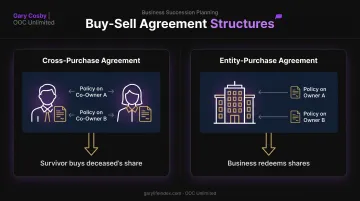
A buy-sell agreement is a contract that governs what happens to a deceased or departing owner's share of the business. There are two common structures:
- Cross-purchase agreements: Each co-owner buys a policy on the other. When one dies, the survivor uses the payout to buy the deceased owner's share directly from the estate.
- Entity-purchase agreements: The business itself owns the policies and redeems the deceased owner's shares. Either way, the death benefit provides immediate liquidity. This prevents a forced sale of business assets during an already time-sensitive estate settlement, when cash is often needed within months, not years.
Key Person Insurance
Some people are hard to replace in the short term: a founder, a top salesperson, a technical lead. With key person insurance, the business owns a policy on that individual, pays the premiums, and collects the benefit if they die. That payout helps cover:
- Lost revenue during the transition
- Recruiting and training costs for a replacement
- Reassurance to lenders and investors that the business remains stable
Estate Equalization
When one child will run the business and another will not, estate equalization uses a life insurance death benefit to give the non-active heir value that matches what the active heir receives through the company. The business stays intact, and heirs are treated fairly without forcing a sale or a messy split of ownership.
Irrevocable Life Insurance Trusts (ILITs)
Fair treatment among heirs still leaves a tax question: who owns the policy? An ILIT removes the policy from the insured's taxable estate. If the insured keeps ownership rights—such as changing a beneficiary or borrowing against the policy—the IRS may pull those proceeds back into the estate. Placing the policy in an ILIT reduces that risk and still delivers liquidity when heirs need it. These structures only work when ownership, beneficiaries, and funding amounts are set up correctly. A licensed life insurance agent works alongside your CPA and attorney on the insurance piece. Gary Cosby Jr., licensed in all 50 states, focuses on that funding component and coordinates with the professionals handling your legal agreements and tax strategy.
Types of Life Insurance Policies Used in Succession Planning
Not every business needs the same policy. The right choice depends on how long you need coverage and whether you want cash value built into the plan.
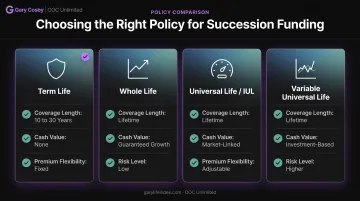
Common options for succession funding include:
- Term life — Covers a set period (typically 10, 20, or 30 years) and pays only if death occurs during the term. Lower cost fits temporary needs, like a five-year transition window before a sale closes.
- Whole life — Guaranteed death benefit and cash value growth for as long as premiums are paid. Coverage does not expire, so it suits buy-sell agreements meant to last the full business relationship.
- Universal life / IUL — Adjustable premiums and death benefits as the business changes. Indexed universal life (IUL) links cash-value growth to a market index and is often used for permanent succession funding with accumulation potential.
- Variable universal life — Universal flexibility plus market-based subaccounts for owners who want investment control and accept market risk.
According to the Insurance Information Institute, those permanent designs map to four recognized types:
- Whole (ordinary) life — fixed premiums, guaranteed cash value
- Universal (adjustable) life — flexible premiums and death benefits
- Variable life — cash value invested in market-based subaccounts
- Variable-universal life — combines universal flexibility with variable investment choices
Tax and Legal Considerations: The Connelly Decision
In June 2024, the Supreme Court ruled in Connelly v. United States, and the decision changed how many buy-sell agreements need to be structured.
The facts: Two brothers owned Crown C Supply together. Their entity-purchase agreement had the company buy $3.5 million in life insurance on each owner. When one brother died, the company used the payout to redeem his shares.
The IRS argued that the insurance proceeds increased the company's value for estate tax purposes, and the Court agreed.
The practical impact:
- Insurance proceeds paid to a corporation for a redemption count as a corporate asset, increasing the taxable estate value
- Entity-purchase agreements may now trigger higher estate tax liability than owners expect
- The Court noted that a cross-purchase structure, where proceeds go directly to the surviving owner rather than the company, may avoid this issue
- Some advisors are also exploring separate LLCs to hold policies outside the operating company
Entity-purchase agreements still have a place. Review yours before the next renewal, not after a death triggers a valuation dispute.
A licensed insurance agent can help structure the funding, but only your attorney and CPA can confirm how a specific agreement will hold up under current tax law.
Building Your Business Succession Plan: Key Steps
A succession plan built under pressure rarely holds up. Start early, while you still control the timeline.
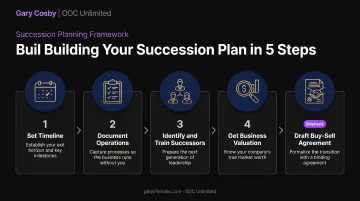
- Set a timeline. Most advisors recommend beginning 3-5 years before an anticipated transition, whether that's retirement or a planned sale.
- Document operations. Write down processes, client relationships, and vendor contacts so a successor isn't starting from zero.
- Identify and train successors. Whether it's a family member, partner, or key employee, give them real runway to learn the role.
- Get a current business valuation. You can't structure adequate insurance coverage without knowing what the business is actually worth.
- Draft a buy-sell agreement. Work with your attorney to formalize the transition terms, then fund it with the right insurance structure.
How Much Coverage Do You Need?
A common personal baseline is the 10x rule (about 10 times annual income). Business owners usually need more. Experian's guidance for business owners starts in a 5-10x income range, then builds upward for:
- Buy-sell agreement funding
- Key person coverage
- Estate tax liquidity
Involve a licensed life insurance professional early. Wrong policy structure is much harder to fix after a valuation is locked in, or after a death, than it is to set correctly from day one.
Frequently Asked Questions
How much does a $1,000,000 life insurance policy cost per month?
Cost depends heavily on age, health, and whether you choose term or permanent coverage. A healthy 40-year-old pays far less than an older applicant or someone with health conditions. A quote based on your age, health, and policy type is the only accurate number.
How do you create a business succession plan?
Set a 3-5 year timeline, document your operations, identify and train a successor, get a current business valuation, and draft a buy-sell agreement funded with life insurance.
What is the success rate of family business succession?
According to Cornell's family business research compilation, about 40% of U.S. family businesses survive into a second generation, and roughly 13% make it to a third.
What is the 10x rule for life insurance?
The 10x rule suggests coverage equal to roughly 10 times your annual income as a starting point. Business owners often need more after buy-sell funding and estate-tax liquidity.
What are the four types of permanent life insurance?
Whole life (fixed premiums, guaranteed cash value), universal life (flexible premiums and benefits), variable life (market-tied cash value), and variable universal life (universal flexibility plus variable investing).