
Without a plan, families end up fighting over what Mom or Dad "really meant." Assets get force-sold to split proceeds. Siblings stop speaking. And it's not rare: older US estimates put will contests at up to 3% of all wills, and the American Bar Association warns of a growing wave of contested probate matters tied to demographic shifts.
This guide covers the practical strategies, life insurance, lifetime gifting, and trusts, that help families divide wealth fairly, not just evenly.
Key Takeaways
- Equal value beats equal shares when a business, home, or farm can’t be divided cleanly.
- Life insurance can offset illiquid assets so one heir isn’t left short.
- Trusts and lifetime gifts cut dispute risk and may keep assets outside the taxable estate.
- Heirs who hear the “why” behind a split rarely contest it—clarity often matters more than the math.
- Complex estates need a coordinated attorney, CPA, and insurance advisor—not a solo plan.
What Is Estate Equalization (and Why It Matters)
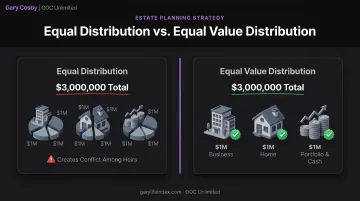
Estate equalization means each heir receives comparable value, not necessarily identical assets. That difference looks like this:
- Equal distribution: Every heir gets the same percentage of every asset (the business, the house, the portfolio).
- Equal value distribution: One child gets the business, another gets the house, a third gets investments or cash, and the total dollar value lines up for everyone.
Picture a family with a $2 million business, a $600,000 home, and a $400,000 investment portfolio, split between two adult children. Forcing co-ownership of the business often creates operational gridlock. Equalization instead gives the business to the child who runs it and offsets the difference with the home, portfolio, or a life insurance payout to the other child.
Why this matters: Contested estates are costly, slow, and emotionally brutal. A 2022 University of Illinois Law Review study of San Francisco probate cases found real friction over exactly these kinds of splits. The goals behind equalization are straightforward:
- Preserve business continuity
- Avoid forced asset sales
- Keep siblings on speaking terms
- Match inheritance to each heir's actual involvement or needs
Core Strategies for Achieving Estate Equalization
Life Insurance as an Equalization Tool
Life insurance is often the cleanest way to offset an asset that can't be divided. If one child inherits the family business or the farm, a death benefit paid to the other heirs can balance the scales without touching the operating asset itself.
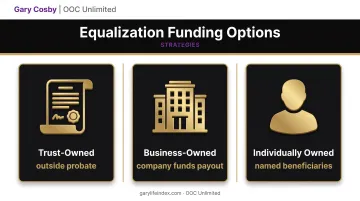
Common structures include:
- Trust-owned policies — death benefit distributes outside probate, on the trustee's schedule
- Business-owned policies — the company funds the equalization payout
- Individually owned with named beneficiaries — proceeds pass directly to heirs you name
Coverage amounts can also be adjusted later if the business doubles in value or real estate prices shift.
GFI × Team OOC licensed agents help families and business owners explore life insurance funding options built around equalization goals, working alongside the family's CPA and attorney rather than replacing them.
Gifting Strategies During Life
When insurance alone can't rebalance the estate, lifetime gifting spreads equalization over years instead of one event at death.
For 2026, the IRS annual gift-tax exclusion is $19,000 per recipient, with a basic estate-tax exclusion of $15,000,000. Gifts to a non-citizen spouse carry a separate $194,000 annual exclusion.
Lifetime gifting supports equalization because:
- It reduces future estate tax exposure by moving assets out early
- It lets parents watch how the gifts land and adjust course
- It can be timed to match milestones (a wedding, a business investment, a first home)
One caveat: document every gift as an "advancement" against the eventual inheritance. Undocumented gifts are one of the most common triggers for sibling disputes decades later, when nobody remembers who got what.
Trusts for Equalization
Gifts and insurance still leave a coordination problem at death. Trusts avoid probate and can include equalization clauses that direct the trustee to rebalance distributions as asset values change.
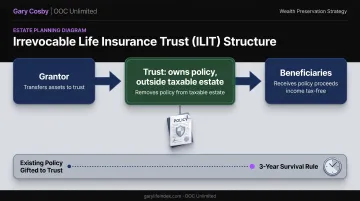
A particularly useful structure is the irrevocable life insurance trust (ILIT). Because the trust owns the policy, not the individual, the death benefit stays outside the taxable estate.
Families usually fund an ILIT in one of two ways: the grantor puts money in the trust to buy a new policy, or an existing policy is gifted into the trust. On the second route, the insured must survive at least three years after the transfer, or the proceeds can be pulled back into the estate.
Trusts also let you build in provisions most wills can't handle cleanly, like:
- Special needs protections that won't jeopardize government benefits
- Spendthrift clauses that release funds gradually instead of in a lump sum
- Equalization instructions that adjust automatically if one asset appreciates faster than another
Navigating Family Business and Real Estate Complications
Splitting a business or property "equally" on paper often creates a mess in practice. Two siblings co-owning a company they don't equally manage is a recipe for conflict, and family business succession planning is under real strain right now.
PwC's 2025 US Family Business Survey found that 44% of family firms said succession planning had impacted the business in the past year. Ownership decisions remain heavily centralized (48% highly centralized, 40% somewhat) in PwC's family business research.
Separately, Kreischer Miller reports 45.9% of family-owned companies still have no formal succession plan at all.
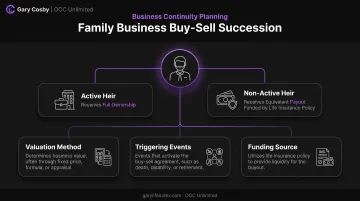
Buy-sell agreements solve part of this. They formalize how business interests move from the active heir (who works in the business) to the non-active heir (who doesn't). A solid agreement typically defines:
- How the interest is valued or priced
- Triggering events such as death, disability, or retirement
- How the buyout will be funded
Life insurance is a common funding tool. Example: a father owns a landscaping company his son has run for a decade, and his daughter has no interest in the work. The buy-sell transfers the business fully to the son, while a life insurance policy pays the daughter an equivalent amount. Everyone gets fair value—nobody is forced into a partnership they did not ask for.
Real estate creates the same trap. Leaving a home or rental to several heirs can lock siblings into joint ownership they never wanted. A cleaner path is to leave the property to the heir who will live in or manage it, then equalize with life insurance or other liquid assets so each beneficiary receives comparable value without co-owning the real estate.
Family Communication and Avoiding Disputes
Here's the uncomfortable truth: disputes usually start with perception, not the numbers on the page. Heirs contest estates when unequal treatment feels unexplained or unfair, not simply because the shares differ.
Kiplinger puts it simply: what's equal isn't always fair, and what's fair isn't always equal.
A few practical tips for the conversation:
- Pick the right moment: not at a holiday dinner, not during a health crisis. Schedule it deliberately.
- Bring documentation: showing the actual reasoning (asset values, buy-sell terms, insurance payouts) beats a vague explanation.
- Involve your advisors: having the attorney or agent in the room lends objectivity and answers questions parents may not be equipped to handle.
Heirs who understand why the split looks the way it does are far less likely to contest it later.
Special Situations: Excluding In-Laws and Blended Families
Some plans focus less on sibling balance and more on two harder cases: shielding an inheritance from a child's spouse, or balancing a second marriage with children from a first marriage.
Keeping Assets Separate from Marital Property
- An outright gift or bequest can become marital property depending on state law and how the funds are used
- Placing the inheritance in a trust, with the child as beneficiary rather than co-owner, generally keeps it separate
- The child can still use trust assets without giving a spouse a legal claim to them
Blended Families and QTIP Trusts
For blended families, a QTIP trust (qualified terminable interest property trust) is the usual structure. Under 26 U.S. Code § 2056, the surviving spouse can receive income for life from the trust assets.
The underlying property then passes to children from a prior relationship when the spouse dies. The spouse can benefit from the assets but cannot redirect who inherits them later.
A Montana State University Extension guide shows the pattern clearly: farm assets go into a QTIP for a surviving spouse's lifetime benefit, and that spouse cannot change the beneficiaries. At death, the property passes to the deceased spouse's daughter on the path set in the original plan.
Working With the Right Professionals
Estate equalization isn't a solo project. It requires three professionals working from the same playbook:
| Professional | Role |
|---|---|
| Estate attorney | Drafts trusts, wills, buy-sell agreements; handles state-specific law |
| CPA | Advises on tax exposure and structuring |
| Licensed insurance agent | Designs and funds the life insurance component |
GFI's licensed agents have access to 25+ A+ rated carriers and focus on the insurance side of equalization. Legal drafting and tax strategy stay with the family's own attorney and CPA. That division of labor matters: no single professional should handle all three jobs.
Once the team is in place, review the plan periodically—ideally every two to three years, and always after a major life event such as marriage, divorce, a birth, or a business sale. Asset values shift, and a plan built five years ago may no longer reflect what's actually fair today.
Frequently Asked Questions
How do you divide an estate equally?
Dividing "equally" can mean giving each heir the same percentage of every asset. For complex estates with a business or property, distributing equal value through different assets of comparable worth usually works better.
How can I leave my inheritance to my daughter but exclude her spouse?
Place the inheritance in a trust for her sole benefit rather than gifting it outright. This generally keeps assets separate from marital property, though rules vary by state, so consult an estate attorney.
Is estate equalization the same as estate planning?
No. Estate equalization is a specific strategy within the broader estate planning process, focused on fairness among heirs rather than the full scope of asset transfer and tax planning.
What's the difference between equal and equitable inheritance?
Equal means identical shares of everything. Equitable means each heir receives comparable value based on their circumstances, which may look very different asset-by-asset.
Do I need life insurance for estate equalization?
It's not mandatory, but it's one of the most common and flexible tools available, especially when illiquid assets like a business or home are involved.
How often should an estate equalization plan be reviewed?
Every two to three years, or sooner after major life events like marriage, divorce, a birth, or a business sale.