That delay carries real consequences: family disputes over who runs the business, a tax bill that catches heirs off guard, or a company that simply can't survive the transition. Gallup's 2025 research found that a third of small-business owners have no plan or aren't sure what happens to their business when they step away.
Succession planning isn't just picking a successor. It's an ownership transfer plan backed by enough liquidity to actually fund it. This guide covers the legal structures, California-specific tax rules, and the funding strategies — including life insurance — that make a transition survivable instead of chaotic.
Key Takeaways
- Succession planning covers leadership, ownership transfer, tax exposure, and funding — not just naming a successor
- Buy-sell agreements only work when they're properly funded, usually through life insurance
- California's tax rules (franchise fees, no capital gains break) shape how you should structure a transition
- Starting five to ten years out preserves the most options and reduces forced decisions
What Business Succession Planning in California Involves
Succession planning has two separate tracks that often move on different timelines:
- Management succession — who actually runs day-to-day operations
- Ownership succession — who holds the equity and receives the financial benefit
A family member might take over management years before they (or anyone else) inherits ownership. Treating these as one decision is a common mistake.
The Core Documents
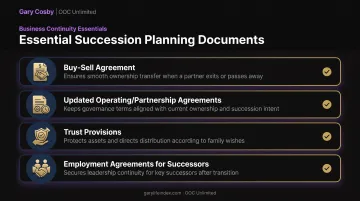
A real plan rests on a handful of legal instruments:
- Buy-sell agreement — sets the terms and triggers for an ownership transfer
- Updated operating or partnership agreements — reflect the intended transition
- Trust provisions — coordinate business assets with the broader estate plan
- Employment agreements for successors — formalize the new leadership structure
Skipping these documents carries real risk. The Family Business Institute reports that 43% of family-owned businesses operate without a formal succession plan, according to its succession-planning research.
California's Community Property Wrinkle
If you're married, California Family Code Section 1100 matters:
- A spouse can't give away or sell community business property for less than fair value without the other spouse's written consent
- If the business is substantially all community property, you must give prior written notice before selling, leasing, or encumbering it — even if your spouse isn't involved in daily operations
Skip this step, and you're not just risking a family fight. You're risking the transaction itself.
Community property consent is only one piece. Without a full plan, control defaults in this order:
- Governing documents
- Any buy-sell agreement
- Court orders
- Your general estate plan
That's a lot of ground for a probate judge to cover instead of you.
Choosing a Succession Strategy That Fits Your Business
There's no single "right" exit. The strategy depends on who's ready, what the business is worth, and what you actually want.
Passing the Business to Family
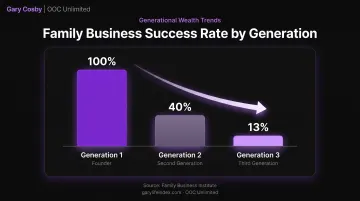
This path carries the heaviest emotional weight, and the highest failure rate. Cornell's Smith Family Business Initiative puts second-generation transition success at roughly 40%, dropping to just 13% by the third generation.
Start with an objective evaluation:
- Does the successor have real operational experience, not just a title?
- Have they run a department, a P&L, or a division independently?
- Would you hire this person if they weren't family?
Selling to a Key Employee or Co-Owner
Internal sales tend to go smoother because the buyer already understands the business. An existing buy-sell agreement removes guesswork on price and timing.
Seller financing, where you carry part of the note, often bridges the gap between what a key employee can pay upfront and what the business is worth.
Selling to an Outside Buyer
Going to market requires groundwork first:
- A professional business valuation, not a guess
- Clean financials that can survive due diligence
- Realistic timeline expectations: outside sales rarely close fast
Funding the Transition: Why Insurance Is the Missing Piece
Here's where a lot of otherwise solid plans collapse. You can have a perfectly drafted buy-sell agreement and still fail, because nobody arranged the cash to actually fund the buyout.
Without liquidity, remaining owners face ugly choices: drain operating capital, sell business assets under pressure, or take on debt at the worst possible moment. Life insurance is one of the most widely used tools nationally for solving this liquidity gap.
How Insurance-Funded Buy-Sell Agreements Work
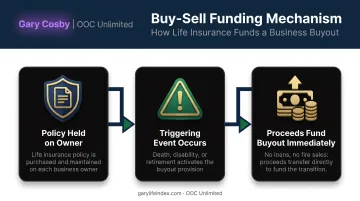
The mechanics are straightforward:
- The business or co-owners hold policies on each owner
- A triggering event (death, disability, retirement) activates the payout
- Proceeds fund the buyout immediately: no loans, no fire sales, no waiting
This keeps the business running while ownership changes hands.
Key Person Insurance: A Related but Different Tool
Key person insurance protects the business itself, not just the ownership transfer. If a founder, top salesperson, or technical lead dies unexpectedly, the business owns the policy and receives the payout. That cash can replace lost revenue, fund a search for a replacement, or reassure lenders who are nervous about continuity.
A buy-sell agreement without funding is just a document. It's the insurance that turns it into a workable plan.
GFI × Team OOC's licensed life insurance agents focus on that funding layer. They don't draft the buy-sell agreement (that's the attorney's job), and they don't perform the valuation.
They identify and structure the insurance so the agreement has cash behind it when a triggering event occurs.
Minimizing Tax Exposure in a California Succession Plan
California's tax rules don't mirror federal ones, and that gap trips up a lot of business owners.
Entity-Level Costs
Every LLC doing business in California owes an $800 annual franchise tax, according to the Franchise Tax Board. S corporations face the same $800 minimum, plus a 1.5% tax on California-source income. These costs factor into whether restructuring makes sense before a transition.
No Break on Capital Gains
Unlike the federal system, California taxes all capital gains as ordinary income. There's no reduced rate for long-term holdings. A sale that looks tax-efficient federally can still generate a sizable state bill.
Reducing Taxable Estate Value Over Time
Sale taxes are only part of the picture. California has no state estate tax, but federal estate tax can still apply to larger estates—so many owners reduce that exposure before a transition.
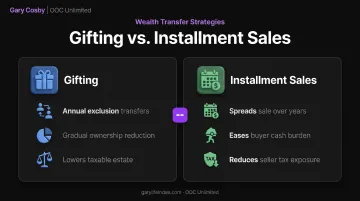
- Gifting — using annual exclusions to transfer ownership stakes gradually, reducing what's left in the taxable estate
- Installment sales — spreading the sale over years, easing both the buyer's cash burden and the seller's tax exposure
None of this works in isolation. Gifting strategies, installment sale structures, and entity decisions require your attorney, CPA, and insurance professional coordinating together — working from one shared plan.
When to Start and How to Keep the Plan Current
Waiting until you're ready to retire is waiting too long.
Start five to ten years before your anticipated transition. That window allows for phased ownership transfers, real successor development, and time to fix problems before they become emergencies. Regions, in SBA-oriented guidance, recommends at least three to five years minimum. Treat that as the floor, not the target.
A plan isn't a one-time document. Revisit it when:
- Business valuation shifts significantly
- Family or ownership circumstances change
- Tax law changes (as it regularly does)
As those goals evolve, structure can evolve with them. California permits entity conversion, such as restructuring from an LLC to a corporation, so owners retain flexibility when succession objectives change.
Frequently Asked Questions
How do I create a business succession plan in California?
Start by identifying a successor, then choose the right legal structure and draft a buy-sell agreement. Arrange funding, typically through life insurance, and coordinate the whole process with an attorney and CPA.
What are the 5 D's of business succession planning?
They're the common triggering events a plan must address: death, disability, divorce, disagreement, and distress. Some versions substitute "departure" for "distress," but the core idea is the same: plan for the unexpected.
What are the key trends in business succession planning in California for 2026?
Expect more employee ownership models, wider use of insurance-funded buy-sell agreements, and closer attention to California-specific tax rules like the franchise tax and capital gains treatment.
What is a buy-sell agreement and why do I need one?
It's a binding contract that sets the terms and funding mechanism for transferring ownership when a triggering event happens. Without one, ownership disputes often end up in court.
Who should be involved in building a succession plan?
You need a coordinated team: an estate planning attorney to draft agreements, a CPA for tax strategy, and a licensed insurance professional to structure the funding. GFI × Team OOC's agents specifically handle that last piece, working alongside your existing advisors rather than replacing them.