That's not a hypothetical worry. S corporations operate under strict tax rules other entities don't face: a 100-shareholder cap, restrictions on who can even hold stock, and a one-class-of-stock requirement that a poorly worded buyout provision can accidentally violate. Add divorce, disability, or a shareholder who just wants out, and you have a recipe for expensive chaos.
This article breaks down the agreement types available, the S-corp-specific tax traps to avoid, how to fund a buyout, and which triggering events your agreement absolutely must address.
Key Takeaways
- Without a buy-sell agreement, S corporations risk losing their tax election through ineligible transfers or a second class of stock
- Redemption, cross-purchase, and hybrid structures each carry different tax tradeoffs shareholders should weigh upfront
- Life insurance remains the most practical funding tool, but ownership structure affects tax treatment and creditor protection
- Death, disability, divorce, and disagreement each need explicit treatment, not vague catch-all language
Why S Corporations Need a Buy-Sell Agreement
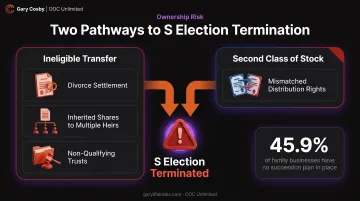
S corporations play by rules that general partnerships and LLCs simply don't. Under IRC Sec. 1361(b)(1)(B), only individuals, certain estates, specific trusts, and certain tax-exempt organizations can hold shares. Corporations, partnerships, and nonresident aliens are off the table entirely.
Here's the problem: life doesn't respect these rules.
Two classic risk scenarios illustrate the danger:
- A divorce court awards company shares to a non-employee spouse as part of a settlement, potentially introducing an ineligible or unwanted owner with voting rights.
- A shareholder dies and leaves stock to multiple heirs or a charity in their will, instantly creating new shareholders the company never vetted.
There's also the one-class-of-stock rule. If different shares end up with different distribution or liquidation rights, even unintentionally, the IRS can determine the company has violated this rule and terminate S status retroactively.
A well-drafted buy-sell agreement fixes these risks by including:
- Transfer restrictions requiring company approval before shares move.
- Notification requirements when a triggering event occurs.
- Indemnification clauses protecting the company if a transfer accidentally jeopardizes S status.
This isn't a theoretical gap. The 2025 Kreischer Miller Family Business Survey found that 45.9% of family-owned companies had no formal succession plan at all. For S corporations, that gap creates business disruption and a direct path to losing the tax status the entity was built around.
Types of Buy-Sell Agreements and Which Fits Your S Corp
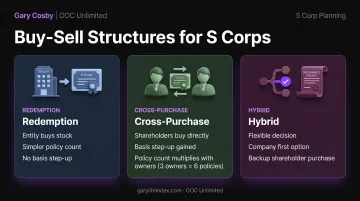
S corps usually choose one of three buy-sell structures. What changes across them is who buys the shares, who owns the life insurance, and whether remaining owners get a basis step-up.
Redemption (Entity-Purchase) Agreements
In a redemption structure, the corporation itself buys back a departing shareholder's stock. The business owns life insurance on each shareholder, pays the premiums, and collects the death benefit to fund the purchase.
Advantage: Simplicity. With three shareholders, you need just three policies total, one per owner, instead of a policy for every possible pairing.
Disadvantage: Because an S corporation is a pass-through entity, funds reserved for redemption don't shelter shareholders from tax the way they might in a C corp. Remaining shareholders also get no increase in their stock basis, since the corporation, not them, made the purchase.
Cross-Purchase Agreements
Here, remaining shareholders buy the departing owner's shares directly, pro-rata, typically funded by life insurance each shareholder owns on the others.
Advantage: Shareholders who buy stock get a basis step-up equal to the purchase price, which reduces future capital gains when they eventually sell.
Disadvantage: The policy math gets ugly fast. With four shareholders, you need 12 separate policies (each owner insuring the other three). Add a fifth owner and that number jumps to 20.
Hybrid Agreements
A hybrid, sometimes called a "wait-and-see" agreement, gives the company first option to redeem shares. If the company declines or can't complete the purchase, remaining shareholders step in as backup buyers.
Advantage: Flexibility at the trigger. Owners can pick the path that fits tax and cash-flow reality then, instead of locking in one method years earlier.
Disadvantage: The agreement is harder to draft, and vague timelines can stall the purchase when speed matters.
Which structure fits:
- Redemption — simpler policy admin; accept no basis step-up for remaining owners
- Cross-purchase — 2–3 owners who want basis step-up and can manage more policies
- Hybrid — optionality at the trigger, with tighter drafting and coordination
Match insurance ownership and beneficiaries to the structure you sign. Have your CPA and attorney model basis and cash-flow results before you finalize.
Special Tax Considerations Unique to S Corporations
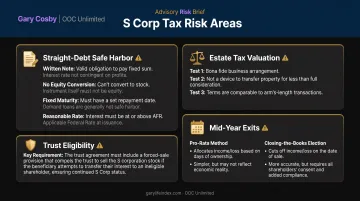
S corporation buyouts carry tax landmines that don't exist for other entity types. Four deserve close attention.
Straight-debt safe harbor. If the buyout is funded through an installment note rather than a lump sum, that note must satisfy Sec. 1361(c)(5)'s straight-debt requirements:
- A written, unconditional promise to pay a sum certain on demand or a specified date
- Interest and payment terms that aren't contingent on profits or borrower discretion
- No conversion feature into stock
- A qualifying creditor (generally an individual, not a corporation or ineligible trust)
Fail any of these, and the note can be recharacterized as a second class of stock, terminating S status.
Estate tax valuation. Under Sec. 2703, the IRS can disregard your buy-sell price for estate tax purposes unless the arrangement meets three tests:
- Bona fide business arrangement
- Not a device to transfer wealth to family for less than fair value
- Terms comparable to arm's-length deals
Skip this, and the IRS may substitute its own valuation at the worst possible time—right after a death.
Trusts, estates, and eligible holders. Not every trust qualifies to hold S corp stock. The agreement should force a sale before shares pass into a non-qualifying trust or estate structure.
Mid-year exits. When a shareholder leaves mid-year, income and loss allocation matters. Two approaches apply:
- Default (Sec. 1377(a)(1)): divide items pro rata by day
- Election (Sec. 1377(a)(2)): if the corporation and all affected shareholders agree, close the books on the departure date
Your agreement should specify which method applies.
Common Triggering Events to Address
A buy-sell agreement is only as strong as the events it covers. Leave one out, and you're back to the informal negotiation the agreement was meant to prevent.
Events every S corp agreement should address:
- Death – Triggers redemption or cross-purchase, typically funded by life insurance
- Disability – Requires a clear definition tied to the disability policy's claims determination
- Divorce – Names spouses as parties and requires signed transfer restrictions upfront
- Retirement – Sets terms for a planned, voluntary exit
- Bankruptcy or creditor claims – Blocks creditors from seizing stock and becoming de facto owners
- Shareholder deadlock – Provides an exit when owners can no longer agree
Disability deserves special attention. Vague language like "unable to work" invites disputes. Tying the trigger to an actual disability insurance policy's determination gives everyone an objective, third-party standard instead of an argument.
Funding the Buyout: Where Insurance Fits In
Even a perfectly drafted agreement is worthless if nobody can pay for the buyout when the trigger hits. S corporation owners are often asset-rich but cash-poor. Their equity is tied up in the business itself.
Common funding methods include:
- Life insurance (death benefit funds the purchase immediately)
- Disability buyout insurance (funds a purchase after a qualifying disability)
- Installment notes (spreads payments over time, must meet straight-debt rules)
- Sinking funds (cash reserves built up over years)
- Borrowing (bank financing at the time of the trigger)
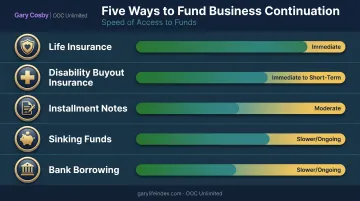
Life insurance tends to be the most efficient option because it delivers cash exactly when it's needed. The company does not have to liquidate assets or take on debt during an already stressful transition. Structuring matters, though. Employer-owned policies must satisfy notice and consent requirements, or proceeds can lose favorable tax treatment under Sec. 101(j).
This is where an insurance professional's role becomes distinct from CPAs and attorneys. Gary Cosby, a licensed life insurance agent at OOC Unlimited, works on the funding side—evaluating and structuring key-person, disability, and buy-sell funding policies.
He doesn't draft the agreement or determine business valuation. That work stays with the client's attorney and CPA. The insurance side makes sure the money is there when the triggering event happens.
Frequently Asked Questions
What are the key differences between a shareholder agreement and a buy-sell agreement?
A shareholder agreement covers broader matters like voting rights and management control. A buy-sell agreement focuses on how shares are valued, transferred, and sold when a triggering event occurs—and many companies combine both in one document.
Does an S corporation buy-sell agreement need to be updated regularly?
Yes. Business valuations shift, shareholder circumstances change, and tax law evolves. Review the agreement and its pricing formula every few years, or after any major business event.
Can a buy-sell agreement accidentally terminate S corporation status?
Yes. Terms that create a second class of stock—such as a non-compliant installment note—or that allow a transfer to an ineligible shareholder can terminate the S election.
Who should be involved in drafting a buy-sell agreement for an S corporation?
Bring in a CPA and attorney for tax and legal drafting, plus an insurance professional to structure the funding mechanism. Each role covers a different part of the agreement.
What happens if a shareholder becomes disabled without a buy-sell agreement in place?
Without a plan, the business may keep sharing profits with a shareholder who is no longer contributing. There is also no clear mechanism or funding source to buy them out.