
But "simple" doesn't mean "risk-free." How much you can actually borrow, what it costs in interest, and how it affects your death benefit depends on your policy's funding history, the loan type you choose, and how well you manage repayment afterward. Many policyholders struggle with the same question: is this the right move for their situation, or could it quietly undermine years of coverage?
This guide walks through whether an IUL loan makes sense for you, the exact steps to request one, the variables that determine your outcome, and the mistakes that trip up unprepared borrowers.
TL;DR
- An IUL loan borrows against your cash value, up to a carrier cap that can reach 90%
- Loans are tax-free while the policy stays in force; an unpaid balance at lapse or death can trigger taxes
- Several years of premiums usually come first before cash value can support a meaningful loan
- Loan type (fixed, indexed, or participating) sets your interest cost and whether collateral keeps earning
- Have a licensed agent review your in-force illustration first to help avoid an unexpected lapse
How to Borrow from Your IUL Policy
Step 1: Confirm Your Policy Qualifies and Check Cash Value
Start by verifying you have cash value to borrow against.
- Confirm you hold a permanent IUL policy, not term insurance; term policies build no cash value and don't qualify
- Check your loan provision in the contract itself; not all policies structure loans the same way
- Log into your insurer's portal or call your agent to see your current cash value
- Confirm your policy hasn't crossed into Modified Endowment Contract (MEC) territory
The MEC rules matter more than most people realize. Under IRS Section 7702A's seven-pay test, a policy becomes a MEC if cumulative premiums paid during the first seven contract years exceed the applicable net level premium limits (IRS guidance).
If your policy is a MEC, loans and withdrawals are taxable as ordinary income to the extent of earnings, and a 10% penalty may apply if you're under 59½.
Step 2: Determine How Much You Need and Can Borrow
Once you know your cash value, figure out your real borrowing capacity.
Carriers commonly cap loans at up to 90% of cash value, though limits vary by insurer and contract. Don't assume every IUL follows that figure.
- Leave a cushion of cash value to cover ongoing policy fees and cost of insurance
- Borrowing too close to your cap raises lapse risk if fees outpace what's left
- Review the loan amount with a licensed agent so it doesn't undermine your long-term coverage
Step 3: Choose Your Loan Type and Submit the Request
Loan type affects both cost and whether your collateral can still earn index credits.
Fixed loans move your collateral into a guaranteed-rate account and disconnect it from index performance. Indexed or participating loans keep collateral exposed to index crediting, so it can still grow while borrowed (usually at a different interest cost).
To submit the request:
- Compare your loan type options with your carrier or agent
- Complete the loan application (often online, via mobile app, or through your agent), with no credit check involved
- Choose your delivery method (direct deposit or check)
- Decide upfront whether you'll pay interest annually or let it accrue
One carrier example: National Life supports online/app loan requests up to $50,000, with larger amounts requiring a form through its Customer Experience Center (National Life). Processing timelines vary; some carriers cite a few business days, others a couple of weeks.
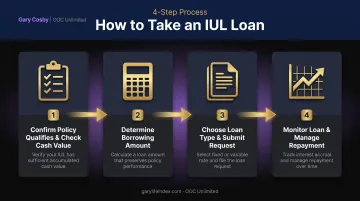
Step 4: Monitor the Loan and Manage Repayment
After funding, stay on top of interest, balance growth, and how repayments are applied.
- Interest typically accrues daily and is charged at your policy anniversary
- Unpaid interest capitalizes: it adds to the loan balance and starts compounding
- Request periodic in-force illustrations to track the loan against remaining cash value
- Make repayments when you can, and label them as loan repayment (not premium) to avoid confusion and lapse risk
When Should You Take an IUL Loan?
An IUL loan isn't automatically the right tool just because it's available. It depends on urgency, your ability to repay, and how mature your policy actually is.
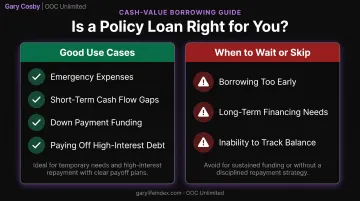
Good use cases:
- Covering an emergency expense without a credit check delay
- Bridging a short-term cash flow gap
- Funding part of a home or major purchase down payment
- Paying off high-interest debt when other credit isn’t available
When to wait or skip:
- Borrowing early in the policy's life, before meaningful cash value has accumulated
- Using the loan for long-term financing needs rather than short-term liquidity
- Taking a loan when you're unlikely to track and manage the balance going forward
Scale matters too. A large loan against a thin cash-value cushion raises lapse risk far more than a modest loan against a well-funded policy—so match loan size to cash value you can comfortably support.
What You Need Before Taking an IUL Loan
Preparation is what separates a loan that helps from one that quietly erodes your coverage.
You need a policy that has accumulated enough cash value—usually after several years of consistent premium payments. According to the NAIC, cash values tend to be low in early policy years and build up over time (NAIC consumer guidance), so borrowing in year two or three often isn't realistic.
Before signing anything, confirm:
- Your policy's specific loan interest rate
- The maximum loan percentage allowed
- Any administrative fees tied to the loan
Talk to a licensed agent or tax professional before borrowing. A quick conversation can flag lapse risk or tax exposure you might otherwise miss.
Key Parameters That Affect Your IUL Loan Results
A handful of variables control both how much you can borrow and what it ends up costing you.
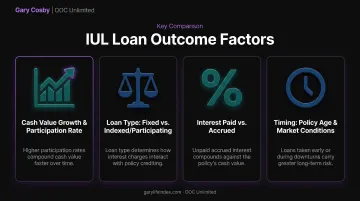
| Parameter | Why It Matters | Impact on Results |
|---|---|---|
| Cash value growth & participation rate | Higher cash value from strong index crediting increases available collateral | Low participation rates or high fees slow growth and shrink borrowing power |
| Loan type (fixed vs. indexed vs. participating) | Fixed loans move collateral to a guaranteed account; indexed/participating loans stay market-exposed | Participating loans can keep earning index credits, usually at a different loan rate and with more collateral volatility |
| Interest paid vs. accrued | Unpaid interest adds to your loan balance and compounds | Paying interest as you go protects cash value and lowers lapse risk |
| Timing (policy age & market conditions) | Borrowing too early limits your options | An indexed loan in a down market year can cut collateral growth potential |
You control loan type (when the carrier offers a choice), whether you pay or accrue interest, and when you borrow. Growth rates and market conditions are not fully in your hands, so walk through these levers with an agent before you take the loan.
Common Mistakes When Taking an IUL Loan
Most problems with IUL loans trace back to one of these:
- Borrowing too early: taking a loan before enough cash value has built up, which risks a lapse
- Letting interest run: allowing accrued interest to pile up without checking it against remaining cash value
- Picking a loan type blindly: choosing fixed vs. participating without understanding how each affects future cash value growth
- Skipping illustrations: ignoring annual in-force illustrations that flag early lapse warning signs
Alternatives to an IUL Loan
A policy loan isn't your only option. Depending on your situation, another route might fit better.
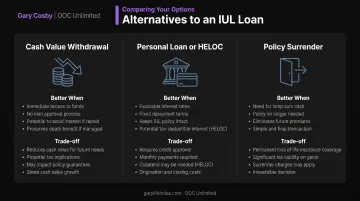
Cash Value Withdrawal
- Better when: you don't want interest charges or a repayment obligation
- Trade-off: permanently and immediately reduces both cash value and death benefit
Personal Loan or HELOC
- Better when: you want your life insurance policy left fully intact
- Trade-off: requires credit approval and may carry higher or less flexible rates
Policy Surrender
- Better when: you need a lump sum and no longer want the coverage
- Trade-off: ends coverage permanently and may trigger surrender charges plus tax on gain above your basis (IRS Publication 525)
Conclusion
IUL loans work best on policies that have had time to mature, with cash value substantial enough to absorb the loan comfortably. If you check in regularly, pay down interest when you can, and track the balance against remaining cash value, you are far more likely to keep the policy healthy.
Most bad outcomes trace back to the same root causes:
- Borrowing too soon
- Ignoring interest accrual
- Pulling out more than the policy can sustain
None of that is hard to avoid. It just takes attention.
Before you request a loan, sit down with a licensed GFI agent and review your specific policy illustration. That one conversation typically clarifies whether your liquidity need and your long-term protection goals can coexist comfortably.
Frequently Asked Questions
Can I borrow money from an IUL or other cash-value life insurance policy?
Yes, as long as it's a permanent policy with sufficient accumulated cash value. Term life policies don't qualify since they build no cash value at all.
How long does it take to borrow money from an IUL?
Once your policy has enough cash value, funds are often available within a few days to a few weeks. Timing depends on your insurer's process and how you submit the request.
How much can I borrow from an IUL's cash value?
Some carriers cap loans at up to 90% of accumulated cash value, but this varies by insurer and policy terms. Check your specific contract for the exact limit.
What happens if a loan against my IUL is not repaid before the insured's death?
Your insurer deducts the outstanding loan balance plus any accrued interest from the death benefit before paying beneficiaries.
Is borrowing against an IUL's cash value a good idea?
It can be, if you can repay on a clear timeline and the policy already has meaningful cash value. Short-term needs fit well; long-term, unmanaged loans raise the risk of a reduced death benefit or a lapsed policy.
How much cash value does a $100,000 life insurance policy typically have?
This varies widely based on policy age, funding level, and structure. Ask an agent for a personalized in-force illustration for a figure tied to your policy.