This scenario plays out more often than most owners realize. A buy-sell agreement is a legally binding contract that spells out, in advance, what happens to an owner's stake when life intervenes. This article breaks down the real advantages, the genuine drawbacks, and the components every agreement needs.
These contracts matter most for closely-held businesses and family companies, where ownership and personal finances are practically the same thing. When one shifts, the other feels it immediately.
Key Takeaways
- Buy-sell agreements set binding ownership-transfer terms before death, disability, divorce, retirement, or a dispute forces a sale
- Life insurance is the most common funding method because it can deliver tax-free proceeds and fast liquidity at a trigger event
- Premium costs, valuation disputes, and unequal funding or ownership burdens are the main drawbacks to plan for
- Choose the structure based on owner count, business size, and succession goals—not a one-size template
Why Do I Need a Buy-Sell Agreement?
Without a written agreement, an ownership stake can land anywhere: an ex-spouse after a divorce, a disengaged heir who's never worked a day in the business, or even an outside buyer looking to force a sale. None of these outcomes serve the business or the remaining owners.
The Supreme Court case Connelly v. United States shows what's at stake even when an agreement exists but isn't structured carefully.
Brothers Michael and Thomas Connelly co-owned a building-supply company, with a redemption agreement funded by $3.5 million in life insurance per brother. When Michael died, the company redeemed his shares for $3 million using the insurance payout.
The IRS disagreed with the valuation. It argued the insurance proceeds should count as a corporate asset before the redemption, pushing the company's value up to $6.86 million and the estate tax bill up by nearly $890,000.
In June 2024, the Supreme Court sided with the IRS. The Court ruled that a redemption obligation doesn't automatically offset the value of life insurance proceeds for estate-tax purposes.
The lesson: a written agreement isn't just about who buys the shares. It needs a valuation method that survives IRS scrutiny. It also has to define exactly which events force a buyout.
Common Triggering Events
Most agreements activate on one of these events:
- Death of an owner
- Permanent disability
- Retirement
- Divorce involving marital property
- Personal bankruptcy
- Voluntary or involuntary departure
Advantages of Buy-Sell Agreements
Predetermined Market and Fast Liquidity
Nobody wants to negotiate a business sale while burying a partner. A buy-sell agreement removes that burden by establishing a ready market for the ownership stake ahead of time.
Life insurance funding makes this practical. Instead of scrambling for cash, the death benefit provides a lump sum that funds the buyout without draining company operating funds. Under IRC Section 101(a)(1), death benefit proceeds are generally received free of income tax, which preserves more capital for the actual buyout.
Clear Valuation Reduces Disputes
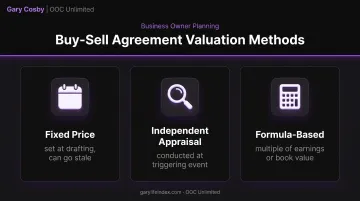
Agreements typically use one of three pricing methods:
- Fixed price — set at drafting, though it can go stale
- Independent appraisal — conducted at the triggering event
- Formula-based — a multiple of earnings or book value
A defined method reduces friction between owners and gives the IRS less room to challenge the number later, provided the agreement qualifies as a genuine business arrangement under IRC Section 2703.
Keeps Control Where You Want It
Agreements restrict who can become an owner. Family businesses use this to keep shares inside the family; partnerships use it to keep control among active owners rather than passive heirs.
Without these limits, shares can pass to someone with no role in the business, including heirs who want a quick cash-out or hold conflicting interests.
Structure Flexibility
You can structure agreements as cross-purchase, redemption, or hybrid arrangements, depending on owner count and succession goals:
- Cross-purchase — remaining owners buy the departing owner's shares
- Redemption — the company buys back the shares
- Hybrid — combines both approaches, often as the owner count grows
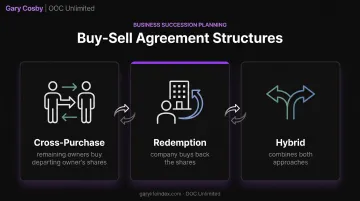
A two-partner firm and a ten-partner firm can both use the same legal tool, just structured differently.
Disadvantages of Buy-Sell Agreements
Ongoing Premium Costs
Life insurance premiums are typically paid with after-tax dollars, and this adds up over decades. For a business with several owners, this can strain cash flow year after year, especially when the payout may not happen for another twenty or thirty years.
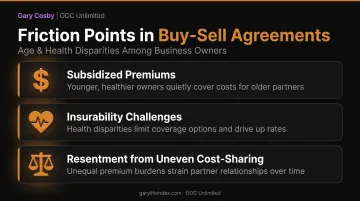
Age and Health Disparities
If one owner is 62 and another is 34, their insurance costs won't match. This can create real friction:
- Younger owners effectively subsidize older, costlier premiums under certain structures
- Health conditions can make coverage expensive or unavailable for some owners
- Uneven cost-sharing can breed resentment even when everyone agreed to the arrangement upfront
Vague Language Leads to Litigation
The CPA Journal documents a case where an agreement used the term "fair value" for an appraisal, but the price defaulted to "fair market value" if the deal wasn't completed within 90 days. These aren't the same standard, and the difference produced a swing of millions of dollars.
In True v. Commissioner, a tax-book-value formula produced values so far below fair market value that the Tax Court found it existed specifically to lower estate values, not to reflect real worth.
An agreement left unreviewed for a decade often fails when owners need it most.
The Redemption vs. Cross-Purchase Tax Trap
Connelly v. United States shows how redemption funding can hurt heirs. A redemption may favor the surviving owner while shortchanging the departing owner's estate.
Insurance proceeds used for the buyout can still count in the company's value for estate-tax purposes. Heirs then face a larger tax bill without receiving more cash.
Rigid Terms Can Backfire
An agreement built to prevent unwanted outside ownership can also block legitimate transfers, like a gift to a family member. Majority owners can also use restrictive terms to pressure minority shareholders into selling on unfavorable terms. Neither outcome reflects what most owners intend when they sign.
What Should Be Included in a Buy-Sell Agreement?
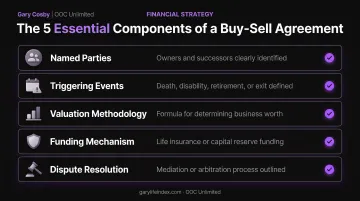
A solid agreement needs five core components:
- Named parties and ownership stakes — who's covered and what percentage they hold
- Triggering events — death, disability, retirement, divorce, and others
- Valuation methodology — fixed price, appraisal, or formula
- Funding mechanism — usually life insurance, sometimes installment notes
- Dispute resolution procedures — how disagreements get settled without litigation
Why Coordination Matters
Vague language and underfunded buyouts are the two most common failure points. That's why the agreement itself should be drafted by an attorney, with a qualified valuation professional setting the value of the business and the ownership interest.
Once those pieces are in place, a licensed life insurance professional can help evaluate funding options. This is the piece Gary Cosby Jr. and the team at OOC Unlimited focus on: reviewing life insurance as a liquidity source for the buyout, working alongside the business's existing CPA and attorney rather than replacing their roles.
OOC Unlimited doesn't draft the agreement or set the valuation. Its focus stays on the insurance-funding component, so the money is actually there when a triggering event hits.
Cross-Purchase vs. Redemption: Choosing the Right Structure
| Structure | Who Buys | Best For | Tax Basis Impact |
|---|---|---|---|
| Cross-purchase | Individual owners buy each other's interests | Small, closely held businesses with few owners | Purchasing owner gets a basis step-up equal to the purchase price |
| Redemption | The entity buys back the departing owner's interest | Larger companies with many owners | No basis increase for remaining owners |
| Wait-and-see | Entity and/or owners (chosen at the trigger) | Businesses likely to change ownership over time | Depends on which option is exercised |
Cross-purchase agreements work well when there are only two or three owners, since each owner personally holds a policy on the others. The tax advantage is real: the surviving owner's basis increases by what they paid, which reduces capital gains if they sell later.
Redemption agreements simplify life for companies with many owners, since the entity holds one policy per owner instead of everyone holding policies on everyone else. The tradeoff is that remaining owners don't get a basis increase, which can mean a bigger tax bill down the road.
Wait-and-see agreements split the difference. The structure isn't locked in until the triggering event actually happens, giving the entity first option to redeem and remaining owners the option to buy whatever's left. This flexibility is useful when a company's ownership situation is likely to change over time.
Choosing between these structures is a legal and tax decision that belongs with the business's attorney and CPA. The insurance-funding piece, meanwhile, needs to match whichever structure gets chosen.
Frequently Asked Questions
Why do I need a buy-sell agreement?
It prevents disputes among surviving owners, ensures liquidity for a buyout, and controls who can become an owner if a partner dies, retires, or exits. Without one, ownership can pass to unintended parties.
What should be included in a buy-sell agreement?
Core components include named parties, triggering events, a valuation methodology, a funding mechanism, and dispute resolution procedures. Missing any of these tends to cause problems later.
What are the disadvantages of a buy-sell agreement?
Ongoing premium costs, valuation disputes from vague language, and unequal financial outcomes between owner types (as seen in redemption structures) are the main drawbacks. Regular reviews reduce most of these risks.
What is the difference between a cross-purchase and a redemption agreement?
In a cross-purchase, individual owners buy each other's shares and get a basis step-up. In a redemption, the business entity buys back the shares, and remaining owners don't receive that same basis increase.
How often should a buy-sell agreement be reviewed?
Most advisors recommend reviewing every two to three years, or immediately after major business or ownership changes. Outdated valuation language is one of the most common sources of litigation.
Can life insurance really fund a buy-sell agreement effectively?
Yes. Death benefit proceeds are generally received free of income tax and provide fast liquidity exactly when it's needed. The tradeoffs are ongoing premium costs and insurability issues if an owner's health changes over time.